 Independent companion activity · Cash Empire Clicker
Two upgrades, one transparent comparison
Try this fictional idle-game example on paper. Upgrade A costs 120 coins and adds 4 coins per second. Upgrade B costs 180 coins and adds 9 coins per second. Divide cost by additional income to estimate simple payback: A needs 30 seconds and B needs 20 seconds. B costs more but repays its price sooner under these assumptions. Ignore multipliers, downtime and future price changes for this exercise. This is original arithmetic practice, not a Cash Empire Clicker level or real investment advice. The app offers its own fictional production and upgrade choices.
 Independent companion activity · Fluxo: Gravity Runner
Five gates, two surfaces
Draw five boxes in a row for a standalone paper runner. Label the safe surface in each box Floor, Ceiling, Ceiling, Floor, Ceiling. Start on Floor before the first box. A switch changes to the opposite surface and is allowed only between boxes. Mark the boundaries where a switch is needed. Answer: switch before boxes 2, 4 and 5, for three switches total. Staying on Ceiling through boxes 2 and 3 avoids an unnecessary move. This is an original logic exercise, not a Fluxo course or timing simulation. The app provides the real floor-to-ceiling runner.
Independent companion activity · Puffgrove: Grove Creatures
Three creatures, three favourite corners
Try an original paper puzzle with three fictional creatures: Moss, Pip and Fern. The available corners are Reading, Climbing and Resting, with one creature in each. Moss is not in Reading or Resting. Pip is not in Resting. Where is everyone? Moss must be in Climbing. With that corner occupied, Pip must be in Reading, leaving Fern in Resting. Draw the three corners and place a named paper token in each. This is a standalone logic card, not a Puffgrove level or a claim about its pets.
 Independent companion activity · PastRush: History Detective
What did the ticket prove?
This is a fictional archive exercise, not a historical event. Exhibit A is a museum ticket dated 12 May with an entry time of 10:00. Exhibit B is a diary sentence: The sculpture was the best part of my visit. Which claim does the ticket support: the ticket displays an entry date and time, or the museum owned a particular sculpture? It supports the first claim, not the second. The ticket alone does not establish attendance. The diary reports an experience but does not independently catalogue the museum. PastRush asks similar questions about what historical exhibits support.
 Independent companion activity · RushOrb: Storm Atlas
Choose the weather for three paper obstacles
Create an original paper route with three obstacles: a ghost bridge, a glass gate and a high hurdle. For this exercise, the supplied rules are Frost holds the bridge, Blaze clears the gate, and Gale helps the hurdle jump. Write the weather sequence before moving a token: Frost, Blaze, Gale. Starting in Frost requires two changes between obstacles. These rules illustrate the broad interactions described for RushOrb, but the paper route is not a native stage or a physics simulation. In the app, movement, timing and the actual course still determine what happens after a weather choice.
 Independent companion activity · Sumthread
Two targets around a four-tile square
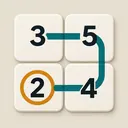
Draw a two-by-two square. Put 1 at top left, 2 at top right, 4 at bottom left and 3 at bottom right. Start on 1. Move only up, down, left or right, never revisit a tile, and use all four tiles. The ordered targets are 3 then 7; reset the running total after the first target. One solution is 1 → 2, then 3 → 4. The segment totals are 3 and 7, and the final target ends on the final tile. This original paper puzzle is not a Sumthread level; the app offers the full native path-puzzle experience.
Interested in the related iPhone app? View Sumthread on the App Store. Check current features, compatibility and access there. This activity is separate from the app; no progress transfers.
 Independent companion activity · Number Puzzles: Sumbriska
Balance two fictional islands with one transfer
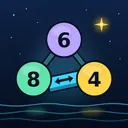
Independent paper puzzle, not a Sumbriska level. Island A holds 9 counters and needs 6; island B holds 4 and needs 7. You may move one packet of 3 counters from A to B. Predict both totals before moving it. The result is A = 6 and B = 7, so both targets are met. Check conservation: the starting total is 13 and the finishing total is also 13. Moving counters changes their location, not their combined number. If a proposed answer totals 14, something was added by mistake. Sumbriska offers its own native bridge rules and boards for players interested in this kind of linked-total reasoning.
 Independent companion activity · Number Beasts: Bond Lab
Carry two into the next beast
Independent arithmetic card inspired by a make-ten rule, not a native level or import code. A shot of 7 meets a beast valued at 5. Together they make 12, so ten is used and 2 remains. That remainder meets a second beast valued at 8; 2 + 8 makes exactly ten, leaving nothing. Write the chain as 7 + 5 = 10 + 2, then 2 + 8 = 10. Both beasts clear under this paper rule. No angles or obstacles are included. Number Beasts adds its own native board geometry, feed and spill behavior; this card explains only the stated arithmetic sequence.