Which came first?
Two events. Tap the one that happened earlier. Ten pairs today, and they get closer together as you go.
Which happened first?
TODAY'S RESULT
0/10
Everyone gets the same ten pairs on the same day. A new set starts at midnight UTC. Nothing is saved or sent.
How the pairs are chosen
The events come from a list of more than fifty moments that each have one widely documented year: a battle, a launch, a first, an opening day. Events with dates historians still argue about are left out, and no pair is closer than three years, so every question has one right answer.
The first three pairs are more than a century apart. The last three can be within the same generation, which is where most people drop points.
Like this? The app has the full version
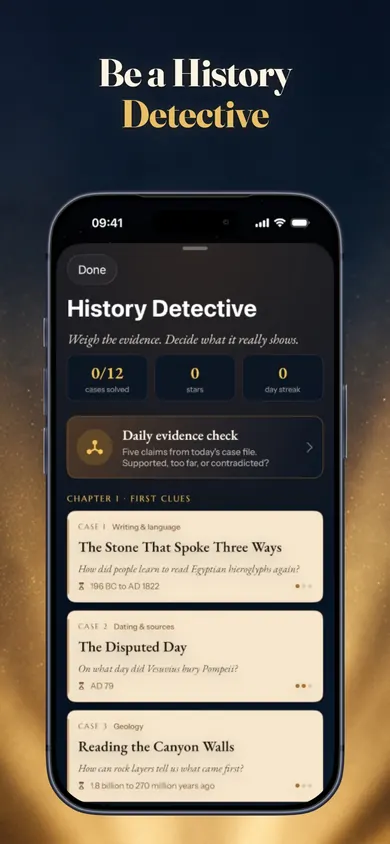
PastRush: History Detective is an iPhone game with a Which Came First? mode of its own, plus:
- 12 investigations with labelled exhibits; six are free, including the Rosetta Stone, Pompeii and Ötzi the Iceman
- Where in the World?: drop a pin on a real map
- 245 globe stories to collect as cards, earned by playing
Free to download for iPhone; six more investigations are a one-time purchase. Details from the app's App Store description, checked 10 November 2026. This web game is a separate companion and its event list is not the app's.
Questions
How does Which Came First work?
You see two historical events and tap the one that happened earlier. Both years appear straight away. There are ten pairs a day and they get closer together as you go.
Does everyone get the same pairs?
Yes. The ten pairs are picked from the date, so everyone playing on the same day sees the same ones and can compare scores. A new set appears at midnight UTC.
Where do the dates come from?
Every event here has a single, widely documented year, such as the Moon landing in 1969 or the Battle of Hastings in 1066. Events whose dates historians still argue about are left out, and no pair is closer than three years.