Wordle
- Rules to hold
- One: guess the five-letter word in six tries
- Needs
- Vocabulary
- Time
- A few minutes
- Forgiving?
- Six tries, then it is over for the day
HONEST LITTLE APPS · SUMTHREAD WEB COMPANION
Reach these sums in order
Number your visits from 1 to 9 or draw a line. Start on any square. Move one square up, down, left or right each time and visit every square exactly once. When a section reaches its target, circle that square and restart the sum at zero on the next square.
Check your route. The last target must end on visit 9. Are the three circled squares in the right order?
Visit all nine tiles once. Move up, down, left or right and make the three sums in order. There’s no timer.
Start on any tile. When your sum hits a target, start counting the next one from zero. Finish the last target on the last tile.
Tap any tile to start.
Each local calendar date has its own web board. Choose a weekday below to play one of the seven original practice boards. Both modes are separate from the iPhone daily.
For a newsletter or puzzle column, download The Switchback reprint edition. Its second page includes the key and reprint terms.
Link to this board · Your last 30 played boards can resume in this browser.
Sudoku asks you to hold nine constraints in your head at once. Wordle asks you to know words. This asks you to add small numbers and not lift your finger. The rule: one path through every tile, no diagonals, no revisits, and your running total must hit each target in order; when it does, the tile locks, and you start counting again from zero. The last target has to land on the last tile. That is the whole game, and it is enough.
A number-path puzzle with one rule: trace a single continuous path through every tile on the grid, up, down, left or right, no diagonals, no revisits, while hitting the ordered target sums at the top in exact sequence. Each time your running sum reaches the active target, that tile locks as a checkpoint and the next segment starts from zero; the final target must land on the last tile. The puzzle above is the same rule on a 3×3 board.
The rule fits in one sentence, the small boards are forgiving, and there is no clock. This web puzzle uses a 3×3 board. In the app, Starter Threads offers small boards, and the daily challenge uses a 4×4 grid.
Count backwards. The last target must finish on the last tile, so the final segment is often the easiest to pin down. Then look for a corner: a corner tile has only two neighbours, so a path can only pass through it one way or start or end there.
The listing describes 100% offline play with no account, no ads and no third-party tracking, and mentions no purchases. We have no evidence of one either way; if that changes we will update this page.
Yes: one fresh 4×4 board generated each day, with local completion history and spoiler-free emoji-grid sharing, per the listing. This separate 3×3 web companion generates its board from the calendar date. Seven original weekday boards are also available as practice.
Finishing a board with zero hints and zero undos. The app gives it a seal; this page gives you nothing but the satisfaction.
7:50Kettle on. The 4×4 daily in the app: targets 9, 12, 12, 13. You start in a corner, because corners only have two ways out.
7:53Second target reached one tile early, which means the segment is wrong, not the arithmetic. Drag back two tiles. The amber ring appears on the right one.
7:57Last target lands on the last tile. The corrected path reaches all four targets. You can share the emoji grid without giving away the route. The kettle has boiled.
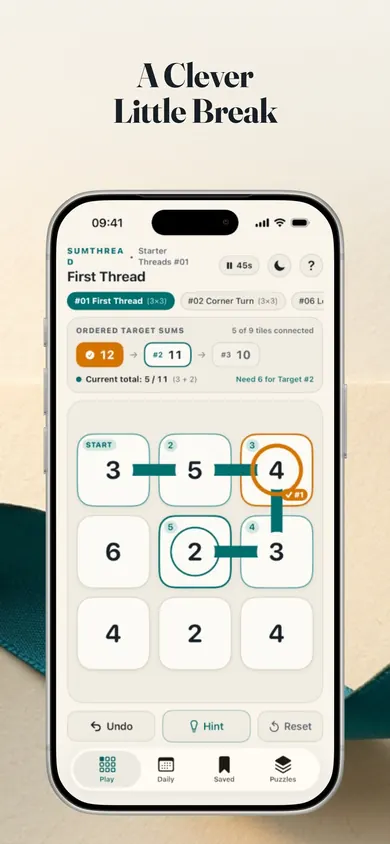
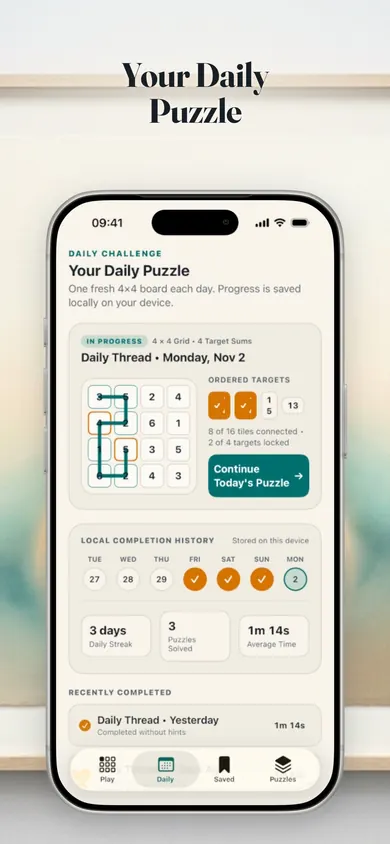
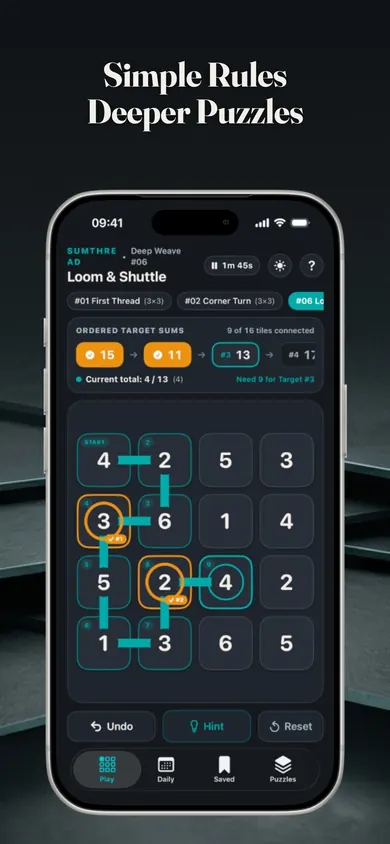
Sumthread. One path, every tile, targets in order. A fresh daily board, five collections, automatic save, no clock. 100% offline, no account, no ads.
This companion uses the app’s published rule and keeps recent board IDs and tile paths in this browser when storage is available. Descriptions of Wordle, Sudoku and KenKen are rule summaries, not reviews.