READ CAREFULLY • THEN TAKE A STEP
Before “what should I do?” ask “what does this say?”
A sentence can sound clear until you notice who said it, who heard it, or the condition you skipped. Practise those reading habits in six short scenes.
Try the free tool ↓Original fictional examples—not Scripture, theology tests or a native app demo.
THE INTERACTIVE WORKSPACE
Read the scene. Keep the context.
No timer or grade. Choose a reading to see its explanation. You can compare all three and revisit a scene.
USE IT IN REAL LIFE
Carry the habit into your next Bible reading.
The scenes above teach ordinary reading checks. They do not settle the interpretation of a biblical passage. Before applying a verse, slow down for these questions:
- Read the surrounding passage. Look for the start and end of the conversation, argument or story. Avoid treating an isolated sentence as the whole message.
- Name the speaker and first audience. Is this narration, dialogue, a quotation within dialogue, or a letter addressed to a particular community?
- Keep the connecting words. Notice “if,” “because,” “therefore” and “but.” Ask what a pronoun refers to instead of filling the gap from memory.
- Notice the form of writing. Poetry, narrative, letters and proverbs can communicate differently. Do not assume every vivid image is a literal instruction.
- Separate what you see from what you infer. Write “the passage says…” separately from “I think this means…” and “one possible step is…”.
When a passage remains unclear
Write the question down. Consult the surrounding chapter, a trusted study resource, or a knowledgeable leader in your faith community. It is better to keep an honest question than manufacture certainty from a fragment.
Practise with Acts 8
Sort six statements about Philip and the traveller into what the passage states, what its details suggest and what it leaves unanswered. Each answer includes a verse-based explanation.
A two-minute note
Text and context: passage reference, speaker, audience, one surrounding detail.
Open question: what you still need to understand.
Possible response: one specific, proportionate action, without claiming the passage promises an outcome it does not state.
FOR GROUPS AND RESOURCE PAGES
Put one reading exercise where your group meets.
The compact version runs all six original scenes without the surrounding article. Before choosing, ask each reader which words support the answer. Invite an open question at the end; no personal disclosure is needed.
Preview the embedded exercise
Add it to a webpage
Paste this HTML into a page that permits iframes. The frame can scroll on small screens. Keep the descriptive title. If your website blocks custom HTML, link to the compact exercise instead.
No account, tracking script, cookies or answer submission. No automatic resizing script is needed. Standard hosting request logs may apply. Embedding is optional and no backlink or endorsement is required.

THE NEXT STEP
Give your daily reading a practical next step.
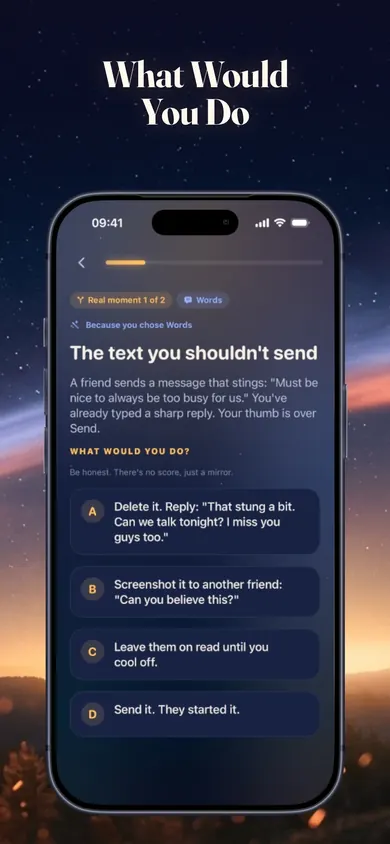
Lampstep pairs a daily real-life scenario with a Bible verse, an explanation and one small action. A short evening check-in helps you reflect on what happened. Today's Fork and the evening check-in are included free.
Explore Lampstep’s daily practice ↗Optional Plus expands scenarios, guided Paths and preparation tools; monthly, yearly and lifetime purchases are listed in the App Store. This free context workshop is separate from the app and does not transfer progress.
Publisher disclosure: Honest Little Apps publishes Lampstep and this companion. This is not an independent review. App details checked November 4, 2026.
Open on your iPhone
On another device? Scan with your iPhone Camera, then tap the link.

Open Lampstep: Bible for Real Life on the App Store
The code opens the App Store. It does not transfer entries or results from this page.
Useful for someone else?
Share the public guide. Your entries and results are not included.
Open the public guide link