Multiplication chart
Every times table, on one chart.
Tap any square to see the fact and its mirror. Switch on patterns to spot multiples, squares and the 9s trick. When you are ready, take the timed quiz, or print a filled or blank chart.
Nothing is saved or sent. A wrong answer in the quiz adds three seconds to your time.
Free tool from Pocket Puzzle Arcade
How to use a multiplication chart
Find the first number down the left side and the second across the top. The square where the row and column meet is the answer. The chart is symmetrical, so 6 × 7 and 7 × 6 are the same square on both sides of the diagonal. Of the 144 squares on a 12 by 12 chart, only 78 are different facts.
Patterns worth finding
- The 9s. The digits of every multiple of 9 up to 90 add to 9: 18 is 1 + 8, 27 is 2 + 7, and so on.
- The 5s. Always end in 5 or 0.
- The 10s. Add a zero. The 11s up to 9 are the digit twice: 33, 44, 55.
- Squares. The diagonal from the top left runs 1, 4, 9, 16, 25. Switch on the square-numbers pattern to see it.
- Even and odd. An odd answer needs two odd numbers, so the odd squares form a grid within the chart.
Learn the hard ones last
Start with the 1s, 2s, 5s, 10s and 11s, which follow simple patterns. Then the 3s, 4s and 9s. That leaves a small set that many children find hardest: 6 × 7, 6 × 8, 7 × 8, 7 × 9 and 8 × 9 are common sticking points. Spend your quiz time there.
Practising with the quiz
The quiz picks 20 different facts at random from 2 to the top of your chart. Answers are timed, a mistake adds three seconds, and after each answer the chart lights the square so you see where the fact lives. Take it a few times a week and watch the time drop. If your time stops dropping, look at which facts you got wrong and practise those.
Printing
Print the filled chart to keep beside homework, or the blank chart for the child to fill in from memory. Both print on one page.
Questions people ask
How do I read a multiplication chart?
Find the first number down the left side and the second across the top. The answer is where that row and column meet.
How many facts are on a 12 by 12 multiplication chart?
There are 144 squares, but because 6 × 7 equals 7 × 6, only 78 are different facts.
What is the trick for the 9 times table?
The digits of each multiple of 9 up to 90 add up to 9. For example 63 is 6 + 3 = 9, and 54 is 5 + 4 = 9.
Can I print a blank multiplication chart?
Yes. Choose Print blank chart for a practice sheet to fill in, or Print filled chart for a reference sheet.

Fluent with the chart? Try a number puzzle.
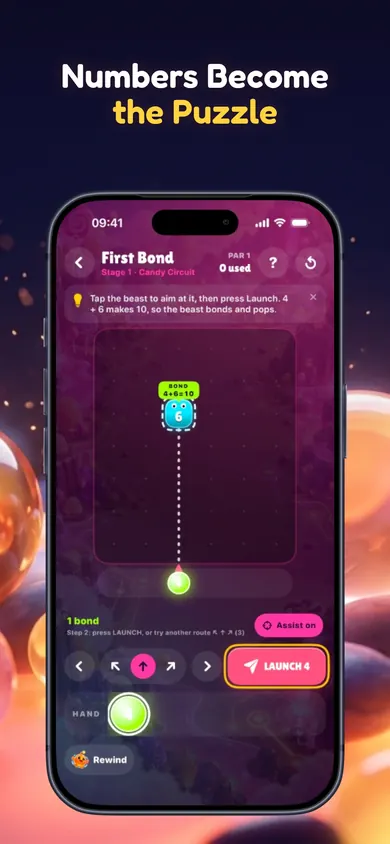
Number Beasts: Bond Lab is an iPhone puzzle game. Numbers become projectiles: you launch the right part at a target to complete the bond, level by level. It is built around number bonds rather than times tables, so it is a different kind of number practice.
Get Number Beasts on the App StoreThe current App Store listing says free, with no ads and no in-app purchases. Check the listing for current details and device requirements.
Honest Little Apps publishes both Number Beasts and this page. This is a separate browser tool and does not sync with the app. App details checked November 10, 2026.
On a computer? Open it on your iPhone