Updated November 2026 · Twelve questions, one calculator, no timer
"Why am I so bad at mental math?"You were taught paper methods. Here is the head one.
Bad at mental math as an adult is almost always a strategy gap, not a brain gap. Type any two-digit sum and watch the make-ten trick do it.
Sumbriska · Free on iPhone, no ads
The bridging calculator
Two numbers. It shows the steps a confident head uses, not the column method.
+
Works for sums up to three digits. Subtraction uses the same idea backwards; try it with a minus sign in the second box.
Tuesday, the restaurant
A composite scenario, not a customer story.
The bill is 86.40 for four people and everyone is looking at Dev, because Dev is "good at numbers", which is a thing people say about anyone who once did it quickly. Dev is not good at numbers. Dev is good at avoiding this moment, and tonight it has arrived.
What Dev does, having read the trick that morning, is not divide 86.40 by 4. It is: 80 split four ways is 20, 6.40 split four ways is 1.60, so 21.60 each. Two steps, both easy, said out loud slowly enough to look casual. Nobody notices the trick. That is the point of the trick.
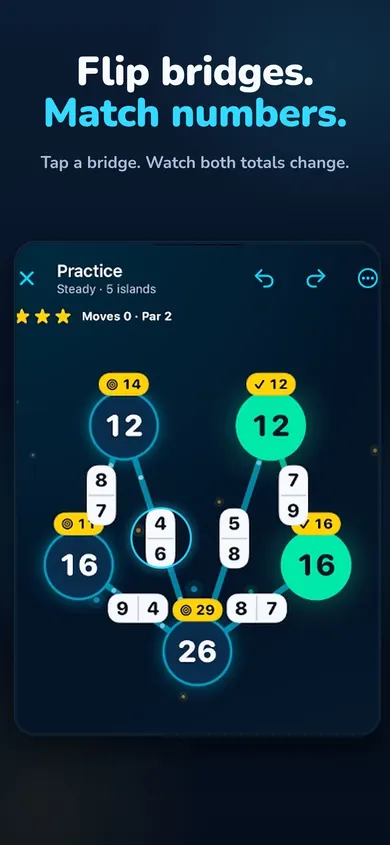
Later, on the bus, a Sumbriska board asks for three bridges into an island marked 26, with 12 and 16 on offer across the water and a 7 and a 4 on the islands behind them. Dev finds it in under a minute, with no one watching, which is how the restaurant was won.
What the quiet practice looks like
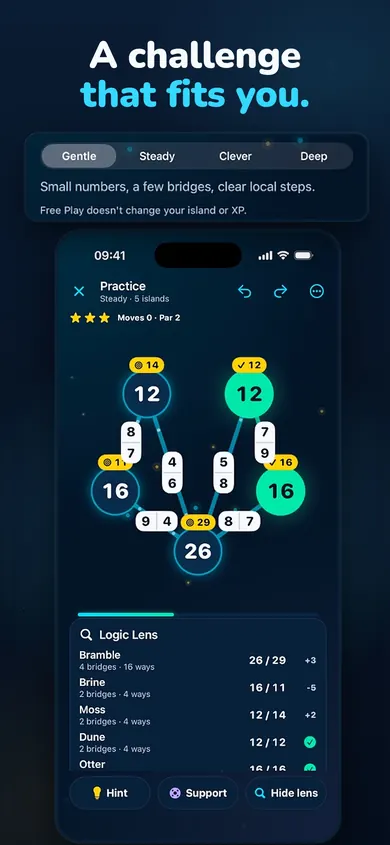
Flip a bridge; two totals change. Find the arrangement where every island is exact.
Gentle to Deep. Free Play does not change your island or XP.
Usually because nobody taught you the tricks, not because something is wrong with you. School mostly taught column methods on paper, which are the worst methods to run in your head. Mental arithmetic is a small set of habits: make ten, round and adjust, work left to right. The calculator above shows the first one on any sum you type.
Is it too late to get better at mental math as an adult?
No. Adults who practise short, regular sessions improve, and the improvement is mostly in strategy rather than memory. National Numeracy, a UK charity, runs a free adult challenge built on exactly that idea: small steps, no shame, no timer.
Could I have dyscalculia?
Possibly, and only an assessment can say. Dyscalculia is a specific difficulty with number sense that is distinct from maths anxiety or gaps in teaching; the British Dyslexia Association has a plain description and routes to assessment. Being bad at times tables is not, on its own, dyscalculia.
Why do I freeze when someone asks me to split a bill?
That is maths anxiety, and it is common: the pressure of being watched eats the working memory you need for the sum. The fix is not more pressure. It is doing sums where nobody is watching until the strategies are automatic, which is why a quiet puzzle beats a timed quiz for most adults.
What is the make-ten trick?
Break one number so the other reaches a round ten, then add what is left. 47 + 38: take 3 from 38 to make 47 into 50, then add the remaining 35: 85. It works because tens are easy to hold in your head and the leftover is small. Type any sum above to see it.
Do number puzzle games actually help?
They help with the part most adults are missing: a relaxed place to practise seeing numbers as parts of other numbers. A Sumbriska board asks you to flip bridges so each island's incoming numbers add to its target, which is make-ten and its cousins over and over, with no clock. We make Sumbriska, so weigh that; we would say the same about any calm, untimed number puzzle.
Is Sumbriska timed?
The Daily board, The Deep and practice boards are not. Harbor Run is a timed mode you choose. Hints, Undo and step explanations are always available and never cost XP, per the listing, so you can learn the logic without a penalty for using them.
Is it free?
The free download includes regions 1 and 2, the Daily board, The Deep and Harbor Run. The optional Voyage Pass is an auto-renewing subscription (4.99 a month or 29.99 a year at the time of checking, no free trial) for regions 3 to 6, side boards and cosmetics. Child profiles have no purchases and no links.
I was told I am "just not a maths person". Is that a thing?
It is a thing people say. It is not a finding. Most of the adults who say it had one bad year with one bad teacher and have been avoiding numbers since. Avoidance is the only part that is real, and it is the part that can change.
How long should I practise?
Ten minutes a day beats an hour on Sunday. One Daily board, or one sum with the calculator while the kettle boils. Stop while it still feels easy.
Which mental math skills matter most for everyday life?
Adding and subtracting two-digit numbers, finding 10% and halving it, and rough multiplication by rounding. Those three cover bills, discounts, cooking and "is this deal real". Nobody needs 17 x 23 in their head.
Should I use a calculator or try in my head?
Both. Use the calculator for the answer and your head for the estimate first; if they disagree by a lot, one of you typed it wrong. Estimating is the skill, and it is the one this page is for.
This page cannot tell you whether you have dyscalculia or maths anxiety; only an assessment or a conversation with a professional can, and the links above are a starting point, not a diagnosis. A number puzzle will not teach long division. What it does is give adults a place to practise seeing numbers as parts of other numbers without a clock or an audience, and we think that is the part most people were never given. We make Sumbriska; the free regions are enough to find out whether it suits you.
Flip bridges. Match numbers.
Free on iPhone. No ads, no accounts, works offline. Child profiles have no purchases.
Open on your iPhone
On another device? Scan with your iPhone Camera, then tap the link.
Try a three-round Sumbriska practice planA six-check practice sheet for learning Sumbriska's bridge sums without rushing: predict one flip, inspect both islands, then explain a correction.
Free daily number puzzle (play online)A free daily number puzzle to play in your browser: flip bridges so every island hits its target sum. New board every day, solution behind a tap.
Useful for someone else?
Share the public guide. Your entries and results are not included.