Dosage calculation practice
Every problem is generated fresh, so you can keep going until it is automatic. Answer, check, and see the dimensional analysis step by step.
Practice problems with made-up orders and no drug names. Follow your program’s rounding rules and your facility’s policies. Never use this page to work out a real dose.
Most dosage calculations come down to one formula: Desired ÷ Have × Quantity. If the order is 500 mg and tablets are 250 mg, 500 ÷ 250 × 1 tablet = 2 tablets. For a liquid of 125 mg per 5 mL, an order of 250 mg is 250 ÷ 125 × 5 = 10 mL. Convert units first so they match (1 g = 1,000 mg, 1 mg = 1,000 mcg, 1 kg = 2.2 lb), and for IV drip rates use volume × drop factor ÷ time in minutes.
Studying the body, not just the math?
Body Unpacked: Health Atlas · free on iPhone
- Body Unpacked follows 14 nutrients after you swallow them on an animated body map: where each is absorbed, carried, stored, used and cleared.
- A physiology lab with step-through models of digestion, breathing and circulation, and the knee-jerk reflex arc, each with short checkpoints.
- An evidence lens that labels health claims by the kind of evidence behind them, with study type and named source.
- Switch any topic between Simple, Standard and Deep dive. Everything stays on your device.
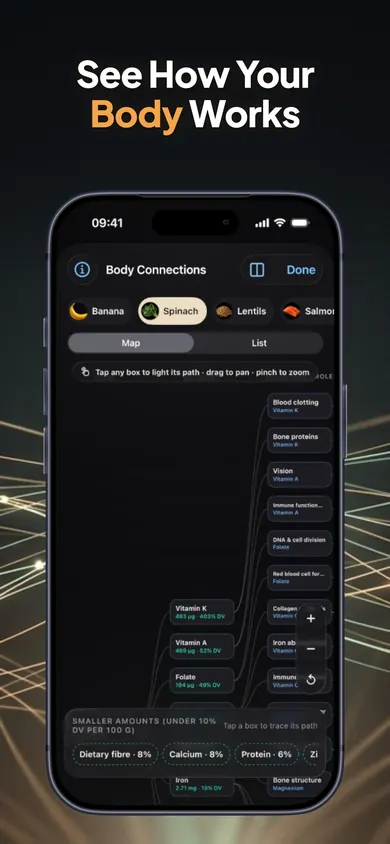
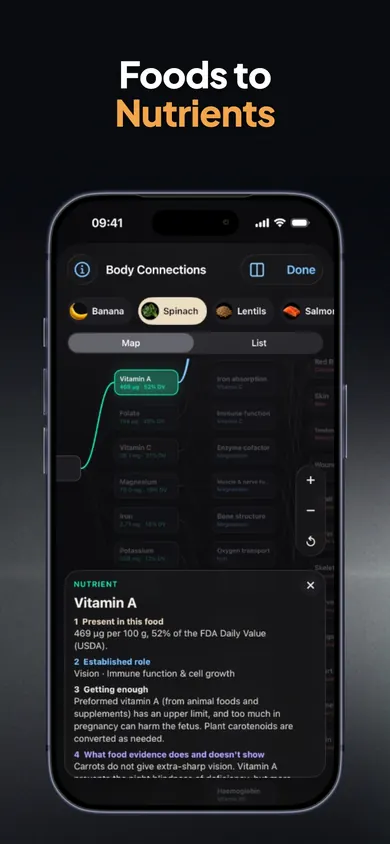
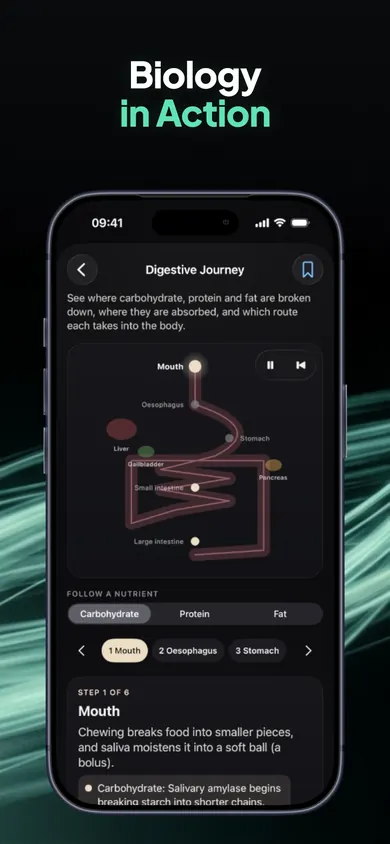
Formula cheat sheet
Desired ÷ Have × QuantityQuantity is 1 for tablets, or the mL the “have” strength comes in.
lb ÷ 2.2 = kgmg/kg × kg = mgVolume (mL) ÷ Time (hr) = mL/hrVolume (mL) × Drop factor ÷ Time (min) = gtt/min1 g = 1,000 mg · 1 mg = 1,000 mcg1 L = 1,000 mL · 1 kg = 2.2 lbTablets to the nearest half, mL to the nearest tenth, kg to the nearest tenth, mL/hr and gtt/min to whole numbers. Your program may differ.
Three habits that stop most mistakes
- Convert first. Get the order and the “have” into the same unit before you do anything else.
- Estimate before you calculate. If the order is twice the tablet strength, the answer is about 2. Anything wildly different means a slip.
- Write the units every step. In dimensional analysis the units you do not want should cancel. If they do not, the setup is wrong.
Revising terminology too? Try the medical abbreviations quiz and medical word parts practice.
Questions
What is the dosage calculation formula?
Desired ÷ Have × Quantity. Desired is the ordered dose, Have is the strength on hand, and Quantity is the form it comes in (1 tablet, or the number of mL that contains the “have” amount).
How do I calculate IV drip rate in drops per minute?
Multiply the volume in mL by the tubing’s drop factor (gtt/mL), then divide by the time in minutes. 1,000 mL over 8 hours with 15 gtt/mL tubing is 1,000 × 15 ÷ 480 = 31.25, so 31 gtt/min.
Should I round kg before calculating a weight-based dose?
Programs differ. This page rounds kg to the nearest tenth first, then rounds the dose to the nearest tenth, and says so on each problem. Follow your own program’s rule on exams.
Are these real medication orders?
No. The numbers are generated for practice and there are no drug names. Never use this page to work out a dose for a real patient.
Does it keep my score?
Only while the page is open. Nothing is stored or sent anywhere.
More free tools
- Medical abbreviations quiz (60 terms)Practise 60 common medical abbreviations (PRN, NPO, BID, WNL, NKDA and more) in four short decks. Multiple choice, instant feedback, a missed list and a study table.
- Complete Anatomy alternativeComplete Anatomy is the pro 3D anatomy app for clinicians. Body Unpacked follows food into your body to show what each nutrient does, privately and offline.
- Bones of the body quizTest your skeleton knowledge with 10 quick questions on bone counts, the femur, the stapes, the hyoid and more. Every answer explains the fact.
- Take the vitamins and minerals quizTen quick questions on what vitamins and minerals do in the body. Instant answers with a plain explanation, a streak counter and a score to beat. Free.