Emergency water calculator
How much water should your household store?
The rule is one gallon per person per day. Set your household below and see what that comes to in gallons, bottles and jugs, how much it weighs, and when to swap it out.
Store at least
12 gallons
45 litres · 4 people × 1 gallon × 3 days
What that looks like on a shelf
- 91half-litre bottles (16.9 fl oz), or 4 packs of 24
- 12one-gallon jugs
- 3five-gallon containers
- 100pounds, roughly. Split it across more than one spot.
Shelf label
EMERGENCY WATER
12 gallons · 4 people · 3 days
Filled or bought:
Home-filled? Replace by:
Ready.gov: replace water you bottled yourself every six months. Keep store-bought water sealed, cool and dark.
The guidance behind the numbers
- One gallon per person per day, for several days. That covers drinking and sanitation. Ready.gov’s basic kit lists use at least three days. A normally active person needs about three quarters of a gallon of fluid a day.
- Some people need more. Children, nursing mothers and people who are sick may need more, and a medical emergency might require additional water.
- Heat changes the sum. More may be necessary in a warm climate, and in very hot temperatures water needs can double.
- Do not ration it. Never ration drinking water unless authorities order it. Drink what you need today and look for more tomorrow.
- Store it properly. Buy commercially bottled water and keep it sealed in its original container in a cool, dark place. If you fill your own, use food-grade water storage containers.
- Rotate what you filled yourself. Water that has not been commercially bottled should be replaced every six months.
All six points restate Ready.gov: Water and Ready.gov: Build a Kit, checked November 10, 2026. Ready.gov says to include extra water for pets but does not give an amount, so this calculator does not invent one. The weight uses 8.34 pounds per US gallon; bottle counts are rounded up.
Gallons by household size
| People | 3 days | 7 days | 14 days |
|---|---|---|---|
| 1 | 3 | 7 | 14 |
| 2 | 6 | 14 | 28 |
| 3 | 9 | 21 | 42 |
| 4 | 12 | 28 | 56 |
| 5 | 15 | 35 | 70 |
| 6 | 18 | 42 | 84 |
| 7 | 21 | 49 | 98 |
| 8 | 24 | 56 | 112 |
One gallon per person per day, before any extra for heat, health or pets.

Water is one line on the list
Keep the rest of the plan in one place.
Family Ready is an iPhone app for the whole household plan. It has a free, editable emergency kit checklist based on Ready.gov and Get Prepared (Canada) guidance, with optional sections for children, older adults, pets and rural homes.
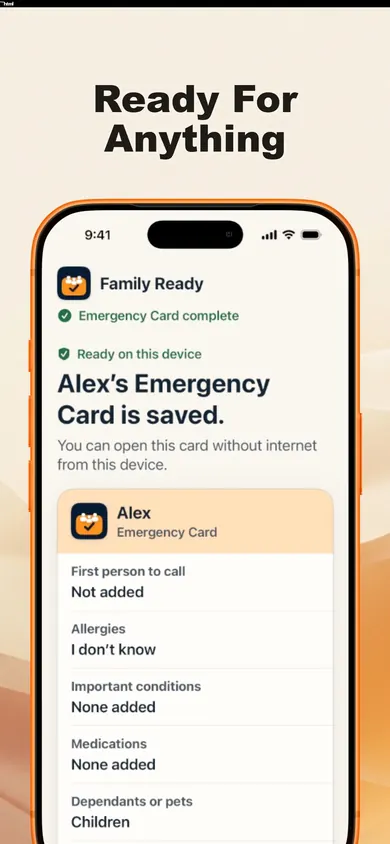
It also keeps a free offline Emergency Card (who to call first, allergies, current medications) and lets you choose a review schedule of 3, 6 or 12 months, which is a sensible moment to rotate water too.
Get Family Ready on the App StoreFree to download, no account needed to start. The Emergency Card, kit checklist, household plan and offline access are free; Family Ready Plus is an optional subscription for sharing, household sync and reminders. Requires iOS 18 or later. Details checked against the App Store listing on November 10, 2026.
Publisher disclosure: Honest Little Apps publishes both Family Ready and this page. This is not an independent review. This calculator is a separate web companion, not a feature of the app. Family Ready organizes information you enter; it is not an emergency-response service.
Quick answers
How much water should I store per person for an emergency?
Ready.gov says to store at least one gallon of water per person per day for several days, for drinking and sanitation. Its basic supply kit lists use at least three days, so the starting point is three gallons per person.
How much water does a family of four need for three days?
Twelve gallons: four people times one gallon times three days. That is about 91 half-liter (16.9 fl oz) bottles, or four 24-packs. For two weeks the same family needs 56 gallons.
Do I need more water in hot weather?
Yes. Ready.gov says more water may be necessary in a warm climate and that in very hot temperatures water needs can double. Children, nursing mothers and people who are sick may also need more, and a medical emergency might require additional water.
How often should stored emergency water be replaced?
Ready.gov says water that has not been commercially bottled should be replaced every six months. Commercially bottled water should be kept sealed in its original container in a cool, dark place; check the date printed on it.
Should I ration water in an emergency?
Ready.gov says never to ration drinking water unless authorities order it. Drink what you need today and try to find more for tomorrow, and lower your need by reducing activity and staying cool.
Know someone who should do this?
Share the public page. Your numbers are not included.
Open the public link