Astrophotography calculator
How long before the stars start to trail?
Pick your lens, sensor and aperture. You get the longest sensible exposure by the 500 rule, a stricter 300 rule and the NPF rule, plus a zoomed preview showing what each one does to a star.
Nothing is saved or sent. These are rules of thumb, not guarantees. Always check a test shot at 100 percent.
The preview is a 5× zoom of a 100% crop, so every pixel of your photo is drawn five times wide.
Free tool from Golden Hour Planner
Why stars trail
The Earth turns, so the stars appear to move. Near the celestial equator, which is the part of the sky that runs overhead from due east to due west, a star moves about 15 arcseconds every second. Keep the shutter open long enough and that motion smears each point into a short line. How long counts as "long enough" depends on how big a star looks on your sensor, which depends on the lens and the pixel size.
The three rules
| Rule | Formula | Notes |
|---|---|---|
| 500 rule | 500 ÷ (focal length × crop factor) | The old standard from the film era. Too long for most modern high resolution sensors. |
| 300 rule | 300 ÷ (focal length × crop factor) | A common stricter version for sharper results. |
| NPF rule | (35 × aperture + 30 × pixel pitch in µm) ÷ focal length | Uses your actual aperture and pixel size, so it adapts to the camera. |
Why the NPF rule is shorter
Modern sensors pack many small pixels, so a stretch that would have been invisible on film shows up when you zoom in. The 500 rule only sees focal length and crop factor. The NPF rule also sees your pixel size and how wide open the lens is, because a wider aperture lets more light in per second and a bigger pixel hides a longer trail.
Aim near the pole and you can go longer
Stars near the celestial pole barely move across the frame. The further you point from the equator, the longer you can expose. The chips in the calculator scale the star stretch to show the effect. Treat a result near the pole as the upper end and check it with a test shot.
What the rules do not cover
- Light pollution. A bright sky fills the sensor faster, so a long exposure may clip before trails matter.
- Foreground. The ground does not trail, but a long exposure picks up wind movement in trees and water.
- Tracking mounts. If you use one, none of this applies. You can expose far longer.
- ISO. Raising ISO lets you use shorter exposures. The best ISO is the lowest one that still shows the stars you want.
Questions people ask
What is the 500 rule in astrophotography?
Divide 500 by your lens focal length, multiplied by the sensor crop factor, to get a maximum exposure in seconds before stars show trails.
Is the 500 rule still accurate?
It is a rough guide. On modern high-resolution sensors it often gives exposures long enough to show trails at 100 percent zoom. The NPF rule or a 300 rule is safer.
What is the NPF rule?
It is a formula that uses aperture, pixel pitch and focal length: (35 × aperture + 30 × pixel pitch in microns) divided by focal length. It adapts to your camera, so it is usually more accurate.
What exposure time should I use for the Milky Way?
Use the NPF figure for your lens as a starting point, then check a test shot zoomed in. Wide, fast lenses at 14 to 24 mm usually land between about 8 and 20 seconds.

The Moon tonight. The Sun every evening.
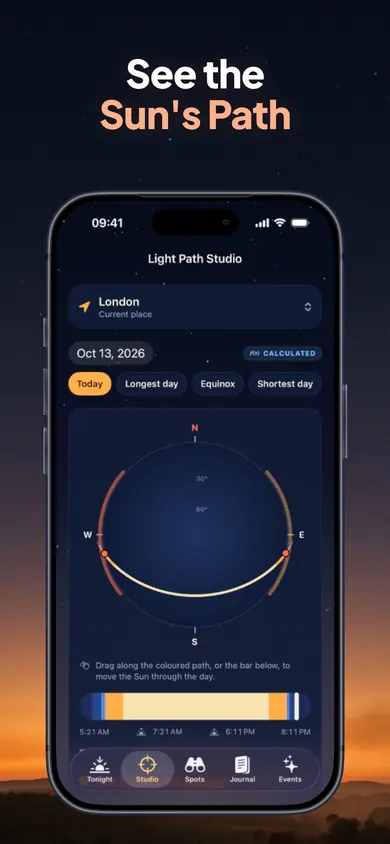
Asterfold: Sunset Planner is an iPhone app for planning an evening outdoors. Its listing describes sun paths and aiming for your viewpoints, tonight's Sunset, Stars and Sunrise ratings with plain-English reasons, and a journal.
Get Asterfold on the App StoreThe free tier includes the Studio and planning for two viewpoints; optional Plus purchases expand viewpoints and other features. Ratings are a rule-of-thumb estimate, not a guarantee, and sun positions assume a flat horizon.
Honest Little Apps publishes both Asterfold and this page. This is a separate browser tool and does not sync with the app. App details checked November 10, 2026.
On a computer? Open it on your iPhone