A composite scenario, not a customer story.
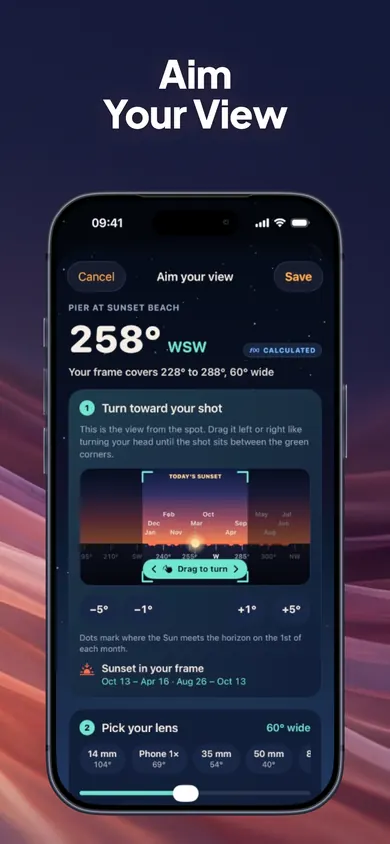
Sam has the ring, a photographer friend called Nia, and a cliff path they walked on their second date. Sunset is 6:27. He picked the spot for the memory, not the light, and only this week thought to ask which way the Sun actually goes down from there. Asterfold's horizon view, turned toward the bench, shows the Sun setting 20° left of the frame, behind the headland, and the dates this year when it sets inside the frame are all in June. In October the bench is in shadow by 5:50.
So the ask moves forty metres up the path to the open rock, where the horizon view shows the Sun landing in the middle of a 60° frame tonight. Nia stands up-slope with the Sun to her right, so the couple glows and nobody squints. At 2 pm the forecast 60 km out toward the Sun is clear, 180 km is cloudy; the forecast alone does not tell them when the cloud will reach the viewpoint. They keep the backup available. They arrive at 4:57, ninety minutes early, because the bus is the bus.
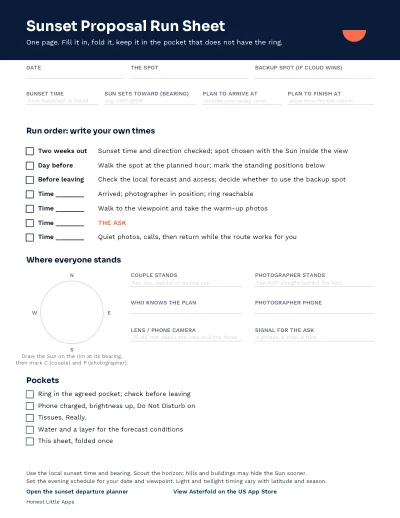
At 5:58, sunset minus 29, Sam stops at the rock. Nia has twenty-six minutes of gold afterwards and uses all of them. At 6:51 the sky is cobalt, the ring is on, and the first phone call is to Sam's mother, who already knew, because her name was on the sheet.