Updated November 2026 · Facts checked against Pew Research and Stanford sources linked below
Second date, sorted.In about sixty seconds.
For people who matched on an app, had a good first date, and now have a chat window that has gone quiet.
SecondYes · Free on iPhone
Draft a message from one to three ideas
Choose example plans to preview a text message. Tap a selected idea to remove it. To send an interactive invitation link, enter your own places and times in SecondYes.
First invitations and browser replies are free. Optional Pro adds unlimited invitations.
What actually happens after a first date from an app?
Short answer: nobody has good public numbers on second dates, but the numbers around them are clear. Three in ten U.S. adults have used a dating site or app, and one in ten partnered adults met their current partner that way, according to a Pew Research Center survey of 6,034 adults conducted in July 2022 (published February 2023). The pipeline from match to couple works for a meaningful minority. The leaky step is the one this page is about: turning "that was nice" into a second plan.
10%of partnered U.S. adults met their current partner through a dating site or app; 20% of partnered adults under 30. Pew Research Center, survey July 2022.
Online meeting is not a niche any more. In a Stanford study of how U.S. couples meet (Rosenfeld, Thomas and Hausen, PNAS, 2019), meeting online had become the single most common way heterosexual couples met by 2017, overtaking meeting through friends. So the "we met on an app" second date is now the ordinary second date.
Why second dates stall (the honest list)
We read the Pew findings looking for the friction, and three numbers explain most of it.
Message overload. 36% of people who used a dating app in the past year often or sometimes felt overwhelmed by the number of messages they received; among women it was 54%. A vague "we should do this again" lands in that pile.
Insecurity about silence. 55% often or sometimes felt insecure about how few messages they got (64% of men). People read a slow reply as a no and stop trying, even when the other person was just busy.
Mixed experiences overall. 53% of ever-users call their experience positive and 46% negative. Every extra round of "what do you feel like?" spends goodwill that is already thin.
None of those numbers are about second dates specifically. We could not find a public, independent dataset on how many first dates lead to a second; the figures that circulate come from dating companies' own surveys, so we are not repeating them here. What the independent data does show is a crowded inbox and a lot of guessing. A concrete, low-effort invitation cuts through both.
A small story (composite, not a customer)
Tuesday, 10:40 pm. Coffee went well. She texts: "That was fun!" He types "We should do it again sometime" and deletes it twice.
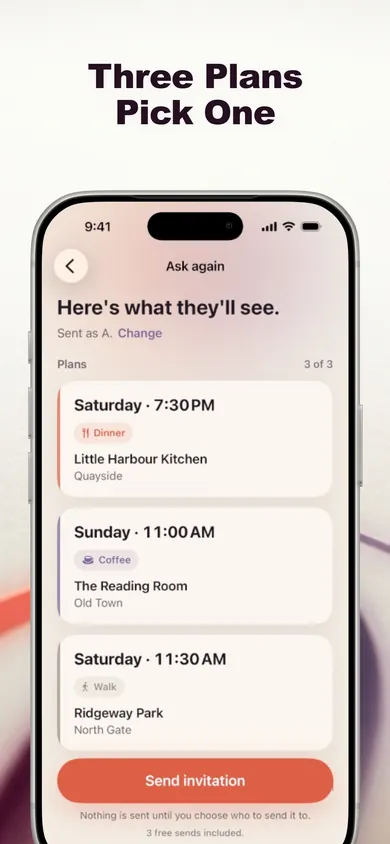
What he sends instead: one link. Inside it are three plans on three different days: ramen and a walk on Thursday, the night market Saturday, a bookshop and coffee Sunday afternoon. Each has a place, a time and a map.
Wednesday, 7:15 am. She opens it in her browser, taps Saturday, and the answer comes back to him as a link in the same chat. He confirms. Two messages, no negotiation, and a ticket with "Add to Calendar" on it.
Where this does not help
If the first date was a clear no for either of you, a tidy invitation will not change that. Three plans in one link is for a "yes, but when?" problem, not a "do they like me?" problem.
Replies travel inside the link you share, through your own messaging app. Anyone who has that link can open it, so share it only with the person you are inviting.
SecondYes is free to download and your first invitations are free; a Pro subscription exists for unlimited invitations and the planning extras. We say this up front because the App Store listing says it, and because a page that hides it would be the kind of page we do not want to write.
It will not plan for you. The app suggests real nearby places from Apple Maps and clearly labels its own curated ideas as ideas; you still choose and edit before you send.
How the invitation works, in three steps
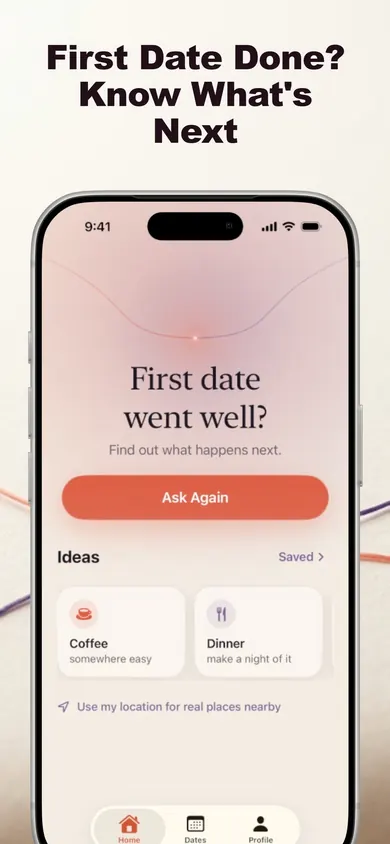
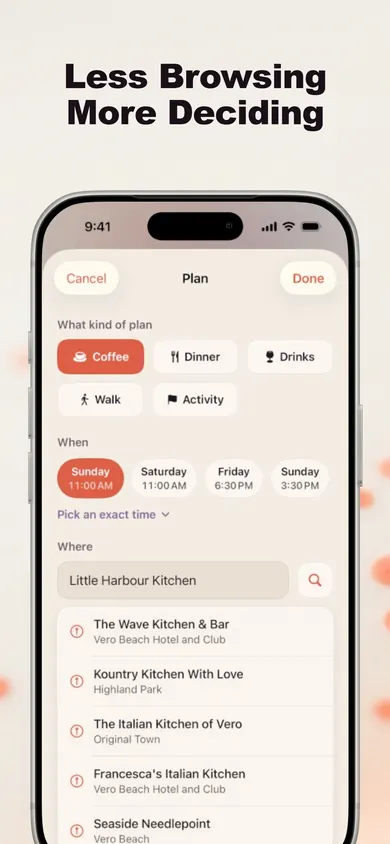
Choose three. Tap a few tiles (kind of date, mood, budget, area, when you are free) and get three different plans on different days, or pick from ideas you saved.
Send one link. Your invitation opens in a normal web browser. No download, no account and no paywall for the person you invite.
They pick, you confirm. Their choice comes back as a link in your usual chat. Confirm it and the date becomes a keepsake ticket with Add to Calendar and directions.
What it looks like
Three plans, one invitation.Tap tiles, get three different plans.What they see, with no app installed.
Questions people ask about the second date
How soon should you ask for a second date after meeting online?
Ask while the first date is still fresh: the same evening or the next day. You do not need a perfect plan to ask; you need a concrete one. "Thursday or Saturday, the ramen place or the night market?" is easier to say yes to than "we should do this again."
Should the second date be longer than the first?
Usually a little. A first date from an app is often a short screening coffee. A second date can be a real activity with a start and a natural end: a walk plus a meal, a market, a show. Keep it under three hours so nobody has to invent an exit.
Is it a bad sign if they take a day to reply?
No. Pew found that 36% of recent dating-app users often or sometimes felt overwhelmed by messages, and 55% felt insecure about how many they got. People are juggling. Send one clear invitation, then give it room.
Who should plan the second date?
Whoever asks, plans. Offering two or three concrete options is not pushy; it is considerate, because it removes the "I don't mind, what do you want?" loop. The other person still picks.
Does SecondYes need the other person to install anything?
No. Your invitation opens in an ordinary web browser. They can pick a plan, ask for another time, or say "not this time" without an app, an account, or a paywall. That is in the App Store listing and it is the reason we built it that way.
Is SecondYes a dating app?
No. There are no profiles, no matching and no strangers. It is for two people who have already met and want the next plan to be easy. Your plans stay on your device; invitation details travel inside the link you share.
Send the plan tonight
Three real options, one link, and an answer that comes back to the chat you already use.
Free on iPhone · No account · Not a dating app
More from this site
Should I go on a second date? Try a private debriefSort interest, comfort, pace and practical hesitation after date one. Six private questions, with an optional local text note and no compatibility score.
How to ask for a second dateWrite a second-date invitation with one to three options that match when you are free. Edit the places, choose a tone and copy the text without an account.