Time card calculator
Add up your week before payroll does
Type when you started and finished each day and how long your unpaid break was. You get hours per day, the weekly total, overtime, and what the gross pay should come to.
Weekly time card
| Day | Start | End | Unpaid break (min) | Hours |
|---|
A shift that ends earlier than it starts is treated as finishing the next day. Nothing you type is saved or sent; refreshing clears it.
This week
Gross pay is before tax and deductions. It is an estimate from the figures you typed, not a statement of what you are owed.
How the maths works
Each day is end time minus start time, minus the unpaid break. The days are added in minutes and only converted to decimal hours at the end, which avoids the small rounding drift you get from converting every day first.
A worked week
Press "Fill in an example week" above to load this one.
| Day | Shift | Break | Hours |
|---|---|---|---|
| Mon | 8:30 to 17:00 | 30 min | 8:00 |
| Tue | 8:30 to 17:00 | 30 min | 8:00 |
| Wed | 8:30 to 18:15 | 30 min | 9:15 |
| Thu | 8:30 to 17:00 | 30 min | 8:00 |
| Fri | 8:30 to 19:00 | 45 min | 9:45 |
| Sat | 9:00 to 13:00 | none | 4:00 |
| Week | 47:00 | ||
At $22.50 an hour with overtime after 40 hours at time and a half: 40 hours × $22.50 is $900.00, and 7 hours × $33.75 is $236.25. Estimated gross pay is $1,136.25.
Minutes to decimal hours
Payroll systems usually work in decimals, which is where a lot of confusion starts: 7 hours 30 minutes is 7.50, not 7.30. Divide the minutes by 60. A quarter hour is 0.25, 20 minutes is 0.33, 40 minutes is 0.67, three quarters is 0.75.
If your pay does not match
- Check the break first. An automatic 30-minute deduction on a day you worked through lunch is one of the most common differences.
- Check the rounding. If your employer rounds to the quarter hour, switch the rounding above and see whether the totals line up.
- Check which week the hours landed in. A shift that crosses midnight on the last day of the pay week can be split across two weeks.
- Then ask, with the numbers in hand. A printed time card showing each day is easier for payroll to check than "I think I'm short".

One week checked. EarnCheck keeps the record for every payday.
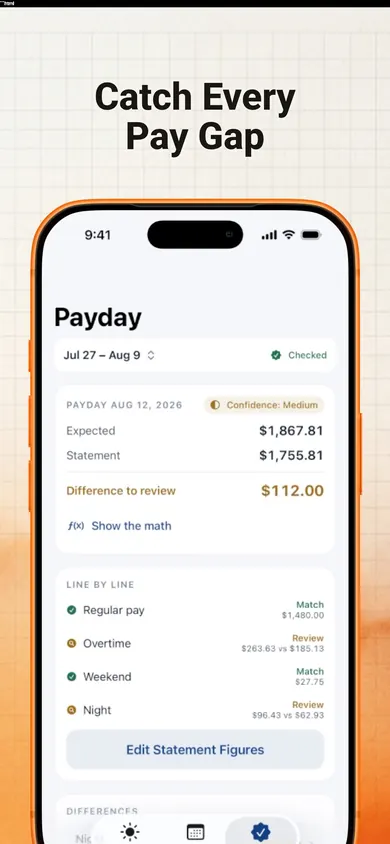
EarnCheck: Shift & Pay Tracker is an iPhone app that keeps your own shift record, separate from your employer's, and lets you compare estimated gross earnings with your pay statement. It supports overnight shifts and shows the calculation behind each estimate.
Get EarnCheck on the App StoreFree and optional Pro features are available; check the App Store for current terms. Estimates are not a statement of wages owed. This calculator is a separate browser tool and does not sync with the app.
Honest Little Apps publishes both EarnCheck and this page. App details checked November 10, 2026.
On a computer? Open it on your iPhone