Updated November 2026 · 12 terms, each with its source
What do attention test scores mean?A plain glossary.
For the person who just finished an online attention test, saw "response control 61" and "consistency 48", and wants to know what those words are measuring.
Attention Age · Free on iPhone
Reaction-time spread: type five comparable times
Use five times from the same task and unit, in milliseconds. This worksheet summarizes only those entries; it does not reproduce Attention Age’s Consistency score or classify attention lapses. Enter positive values up to 3,600,000 ms (one hour), the worksheet’s input limit.
Sort six imaginary parcels without a timer. The dispatch desk changes its rule between cards. After each choice, compare what happens under the other rule.
This original browser exercise counts choices in this round only. It produces no attention-age estimate and sends no result to the iPhone app.
The short answer
An attention test score is a count of how often, how fast and how evenly you responded to a specific set of tasks on a specific day. The words next to the numbers, sustained attention, response control, consistency, distractor handling, object tracking, each name one task family with decades of research behind it. None of them is an age, a percentile or a diagnosis unless the test says exactly where its reference population came from. Below, every term is defined, sourced, and matched to what it looks like inside Attention Age.
How a five-minute attention test works
Three timed tasks. Signal Watch (tap signals, skip decoys), Interference (judge the middle arrow) and Tracking (follow moving shapes): a vigilance task, a flanker task and a multiple-object-tracking task.
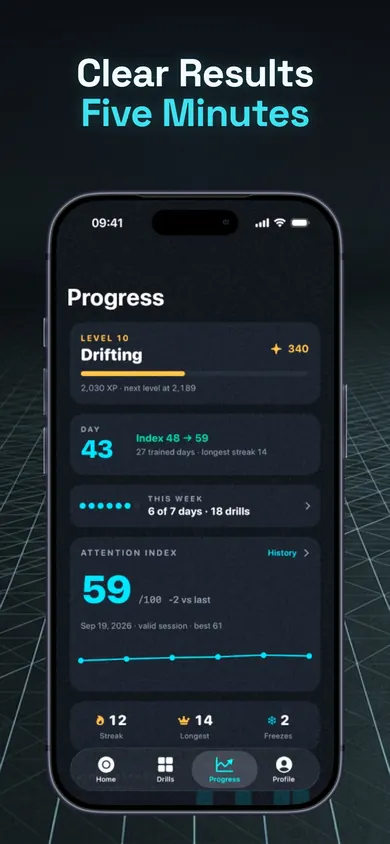
Five category scores and one index. Sustained Attention, Response Control, Consistency, Distractor Handling and Object Tracking roll up into a 0–100 Attention Index, each explained in plain language in the app.
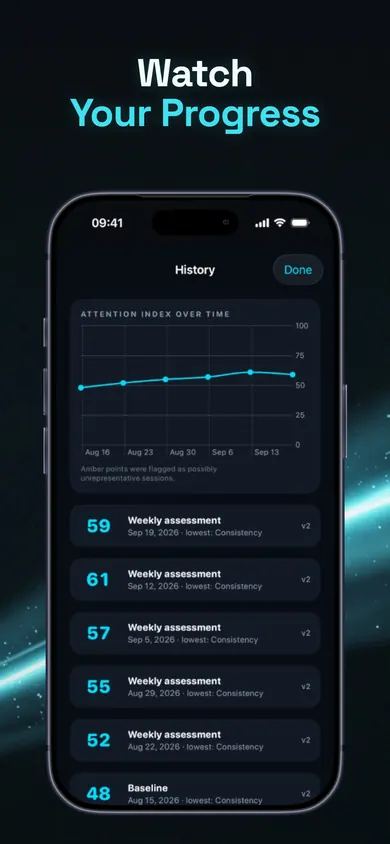
A fair re-test. The same tasks and scoring a week later. Changes under 5 points are called "about the same", early gains from familiarity are flagged, and lower results stay in your history too.
Questions people ask about their scores
Is an attention test the same as an ADHD test?
No. Attention tasks like these are used in research and sometimes alongside a clinical assessment, but a score from an app is not a diagnosis of anything. Attention Age says this in its listing: it is an entertainment and self-practice app, and its index is not a medical, clinical or diagnostic test. If you are worried about your attention, talk to a clinician.
Why are my scores different every day?
Sleep, caffeine, time of day, noise and whether you were interrupted all move attention scores. That is why one number means little and a weekly re-test on the same tasks means more.
What is a good Attention Index?
There is no population table behind it, so "good" only means higher than your own earlier sessions under similar conditions. Changes under 5 points are called "about the same" by the app.
Does practicing the drills improve attention in real life?
Practicing a task reliably improves that task. Whether it transfers to work or study is debated in the research and the app does not claim it does; its listing says scores rising with practice shows improvement at the tasks, not proof of broader change.
How long is the test?
About five minutes: three timed tasks. There is also a 20-second practice challenge and a free Daily Signal, one 20-second challenge per day with the same pattern for everyone on that date.
What different tests actually report
Type of test
What the number is
Watch out for
Web "attention span" quizzes
Often a self-report questionnaire scored into a label
A label is an opinion about your answers, not a measurement
Single reaction-time page
Your fastest or average click time
One task, no decoys, no spread; cannot see lapses
Research-style task battery (what Attention Age runs)
Hits, misses, false alarms and timing across several tasks
Only comparable with your own earlier sessions unless real norms are published
Clinical continuous performance test
Normed scores administered and interpreted by a clinician
Not something an app can replace
Try Arrow Repair
Change one arrow so both the middle arrow and the majority follow their instructions. Six untimed puzzles let you inspect each choice, count your checks and share the same challenge with a friend.
How long you can keep attention on one thing before it drifts. It is a plain-language idea, not a single measured number, which is why no serious test reports "your attention span is 8 seconds". The famous goldfish comparison has no study behind it; the BBC traced the claim and found no source for it (March 2017).
In Attention Age: Attention Age calls your overall result an Attention Index, 0–100, and says in the app that it is not an age, a percentile or a ranking.
Sustained attention (vigilance)
Staying alert for rare signals over minutes, not seconds. Classic lab versions put you in front of a slow stream of events and ask you to respond to the uncommon one. Performance tends to sag as the minutes pass; see vigilance decrement.
In Attention Age: Measured by Signal Watch: tap the signals, skip the decoys, for the length of the task.
Vigilance decrement
The drop in hit rate and the rise in slow responses that appears a few minutes into a monitoring task. It was first measured in Norman Mackworth's 1948 "clock test" with radar operators (Quarterly Journal of Experimental Psychology). A test that is only 30 seconds long cannot see it.
In Attention Age: A reason the full test is five minutes rather than one.
Response control (inhibition)
The ability to not respond: holding back on a decoy, stopping a habit mid-flight. Go/no-go tasks measure it by counting commission errors, the times you tapped when you should have waited.
In Attention Age: Scored as the Response Control category. Decoys in Signal Watch are the no-go trials.
Flanker task (interference)
You judge a middle arrow while arrows on either side point the same way (congruent) or the opposite way (incongruent). The slow-down on incongruent trials is the interference cost, described by Eriksen and Eriksen in Perception & Psychophysics, 1974.
In Attention Age: The Interference task: judge the middle arrow. Feeds the Distractor Handling category.
Multiple object tracking
Keeping several moving shapes in mind at once while they cross paths. Most adults can track about four at normal speed; the task was introduced by Pylyshyn and Storm in Spatial Vision, 1988.
In Attention Age: The Tracking task: follow moving shapes. Feeds Object Tracking.
Reaction time (RT)
Milliseconds from a signal appearing to your response. A single fast time means little; the average over many trials means more, and the spread means most.
In Attention Age: Shown per session in your history, not as a public leaderboard.
Consistency (RT variability)
How much response times vary from trial to trial. Standard deviation describes spread in the original units; coefficient of variation (SD divided by the mean) expresses spread relative to the mean. A calculated spread alone cannot identify a lapse or establish a fair comparison between different tasks, devices or people.
In Attention Age: The app includes a Consistency category. The worksheet on this page demonstrates summary arithmetic only; its values are not that category’s score.
Baseline
Your first honest result, used only to compare you with yourself later. A baseline taken while tired or interrupted is still a baseline, just a noisy one.
In Attention Age: The first five-minute test. Weekly re-tests use the same tasks and scoring.
Practice effect
Scores on any repeated task rise at first because you learned the task, not because your attention changed. A fair test says so instead of selling the bump as improvement.
In Attention Age: Attention Age flags early gains from familiarity and calls changes under 5 points "about the same".
Validity check
A rule that flags a session that probably was not a real attempt: too many misses, impossible speeds, a long pause. Without it, one distracted session poisons the trend.
In Attention Age: Built into every full test; flagged sessions stay in history but are marked.
Norms and percentiles
Comparing your score with a reference population ("better than 72% of people your age"). Honest norms need a large, documented sample on the same device and conditions. Apps rarely have that, so a percentile from an app is usually decoration.
In Attention Age: Deliberately absent. Your index is compared with your own earlier sessions only.
What your calculator result means
The mean is the sum of your five entries divided by five. The sample standard deviation is the square root of the sum of squared distances from that mean divided by four. CV is sample SD divided by the mean, shown here as a ratio rather than a percentage. NIST defines this sample CV and explains its measurement assumptions.
These are descriptive summaries of a very small set. A longer entered time increases the spread, but the calculator cannot tell whether that came from an interruption, equipment, the task, a recording error or something else. There are no validated “typical,” “high consistency” or lapse cutoffs in this worksheet. For the native app’s scoring rules, read Attention Age’s methodology.
Where the words appear in the app
index + 5 categoriesweekly re-tests, lower ones kept
Honest limits
This is general information about attention measurement, not medical advice. If attention problems are affecting your life, talk to your clinician.
Attention Age's index reflects performance on its tasks on your device. It is not compared with any population and is not a diagnostic test; the app says so itself and publishes its methodology.
Three tasks are free to practice; seven more drills, longer daily circuits and 45- and 90-minute deep-work timers are part of the optional Pro subscription. Weekly results are always free and earned results are never locked.
Improving at the drills is improving at the drills. Whether that transfers to studying or work is an open research question.
A fictional comparison note
A fictional person records an index of 48 on Tuesday night and 59 on Saturday morning. They also note different times of day and practice experience. Those two scores do not establish what caused the difference. The notes make the attempts easier to describe without claiming a change in the person’s brain.
The useful habit is not chasing the number. It is re-testing on a similar morning each week and reading the categories, then naming one task and starting a 25-minute session.
Find your baseline
Five minutes, three tasks, a plain-language result. No account, no ads, results stay on your iPhone.
Entertainment and self-practice app · Not a medical test
More from this site
Test your attention span at home (shift workers)Test your attention span at home when you work nights or sleep badly: a sleep-debt check, what a 5-minute attention test can tell you, and when to re-test.
Compare two visual-search attemptsFind the same five targets in two untimed boards, check every choice, and compare the attempts without an age or ability score.