Pattern memory test
How much of the grid can you keep?
Some tiles light up for a moment, then go dark. Tap the ones that were lit. Every level adds a tile, and the grid grows as you go. Three wrong taps costs a life; you have three.
Ready when you are.
Tiles stay lit a little longer as the pattern grows. Works with touch, mouse or keyboard.
What this measures
Holding a pattern of positions in mind for a few seconds uses visuospatial working memory: the part of short-term memory that deals with where things are rather than what they are called. It is what you use to remember where you parked, or the layout of a hand of cards you just glanced at.
How to read your score
Your score is the largest number of tiles you reproduced without losing the level. There is no official scale for this game, and a different grid or display time would give a different number, so compare your runs with each other rather than with anyone else's. A casual on-screen test like this is for fun and practice, not a clinical assessment.
Why it gets hard so quickly
Short-term memory holds only a handful of separate items at once. Early levels fit inside that limit. Past it, you can no longer store each tile on its own; you have to see the pattern as a few larger shapes. That switch, not the extra tile, is what makes the middle levels feel like a wall.
Ways to get further
- See shapes, not tiles. An L, a diagonal, a pair in the corner. Four shapes are easier to keep than eleven squares.
- Soften your gaze. Look at the middle of the grid and take in the whole thing, instead of darting from tile to tile.
- Tap the sure ones first. The clear shapes go in quickly, which leaves less time for the vague ones to fade.
- Use the empty space. On a crowded grid it can be easier to remember which tiles were dark.

Liked that? There are five more a day.
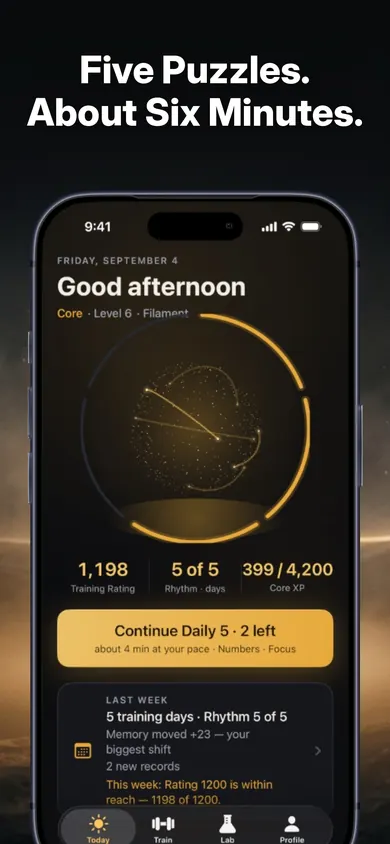
Cognilo: Brain Training Games is an iPhone app of short puzzles. Its listing says the free Daily 5 draws from memory, focus, logic, number, spatial and language puzzles.
Get Cognilo on the App StoreIts listing describes a free Daily 5. Check the App Store for current details on any optional paid features. Brain-training games are practice and entertainment, not a medical assessment or treatment.
Honest Little Apps publishes both Cognilo and this page. This is a separate browser tool and does not sync with the app. App details checked November 10, 2026.
On a computer? Open it on your iPhone