Your kind of stuck
You do not know where to start
The room has forty things wrong with it and no first one. Your brain is trying to sort all forty before moving, so it does not move.
Pick the corner nearest the door. Only that corner. Two minutes.
Updated November 2026 · Five questions, no email, no account
For the mom with ADHD who wants a clean house and cannot make her feet move toward it. Find your kind of stuck, then start one room.
Not a diagnosis. Six ordinary ways a person with ADHD gets pinned in front of a messy room, the same six the Now app asks about when you tap I'm stuck. Answer five questions and the ring fills up.
Your kind of stuck
The room has forty things wrong with it and no first one. Your brain is trying to sort all forty before moving, so it does not move.
Pick the corner nearest the door. Only that corner. Two minutes.
Your kind of stuck
You are seeing the whole house as one task. One task that takes a weekend cannot be started on a Tuesday afternoon, so it is not.
Shrink it until it is almost silly: not "the kitchen", but "five dishes into the sink". Then stop or keep going, your call.
Your kind of stuck
The will is there and the body is not. After a night of broken sleep, a toddler and a work call, there is nothing left to spend on a bathroom.
Choose the one thing that makes tomorrow morning easier (tonight's dishes, the bag by the door) and give it two minutes sitting down if you need to.
Your kind of stuck
You start the laundry, see the mail, open the mail, find a form, look for a pen, and twenty minutes later the laundry is still in the machine and three things are half done.
One visible task, one visible timer. Whatever you notice on the way, say "later" out loud and keep walking.
Your kind of stuck
You cannot vacuum until the toys are up, cannot put the toys up until the bin is emptied, cannot empty the bin until someone finds the bags. The chain has a missing link and the whole chain stops.
Name the missing link in one sentence. If you can do it in two minutes, that is the task. If you cannot, park the whole thing and pick a room that is not waiting on anyone.
Your kind of stuck
You have been "on" since 6 am. The reason you cannot start the kitchen is not the kitchen.
Set a timer for ten minutes and do nothing useful. Then two minutes on the smallest thing. A rest you planned is not the same as avoiding.
Ties go to the answer you gave last, because the most recent one is usually the truest. The result changes nothing about who you are; it changes which two minutes you spend first.
A composite from parents we have talked with, not a customer story.
School pickup is done. The small one is asleep in the car seat on the kitchen floor because moving her is a gamble. The kitchen is the kind of mess that has layers: breakfast under lunch under the craft project. Her husband texts "need anything from the shop?" and she wants to answer "a new house".
She stands in the doorway. Her brain offers the whole room at once: the dishes, the floor, the table, the fridge door that will not shut, the bag for the charity shop that has been "going tomorrow" since August. She picks none of them. She picks her phone, which is at least one thing.
What eventually works is not motivation. It is a smaller target. "Put five dishes in the sink." Not the dishes, five dishes. Two minutes on a timer she can see. At the end of the two minutes she has twelve dishes in the sink, the counter half clear, and the strange, familiar feeling that the hard part was over before it began.
That is the whole trick, and it is not a trick. Sari Solden, a therapist who has written about women with ADHD for decades, puts it plainly in her ADDitude piece on overwhelmed moms: running a home means coordinating many loosely defined, repetitive, unrewarded tasks at once, which is exactly the kind of work ADHD makes hardest. The fix is not to try harder at all of it. It is to make the first step so small the room cannot say no.
Wait for a free Saturday, do everything. Works for some. For many moms with ADHD the free Saturday never comes, and when it does, the house is so far gone that the blitz takes the whole weekend and the resentment lasts longer.
Zones, rotations, a laminated chart. Good systems help when they are running. The trouble is day one of every system is a starting problem, and that is the thing you came here with.
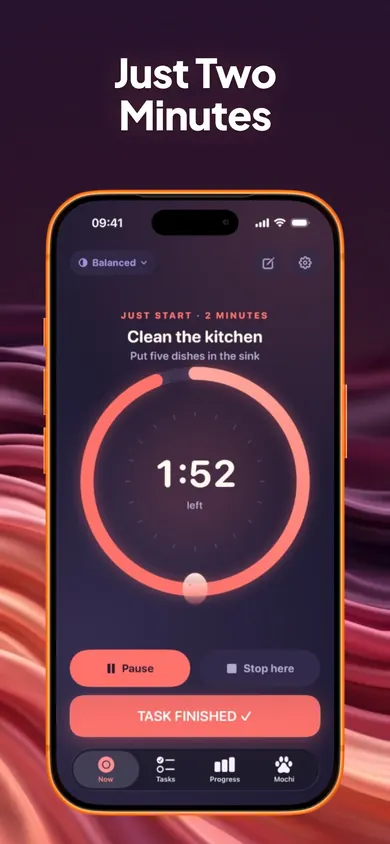
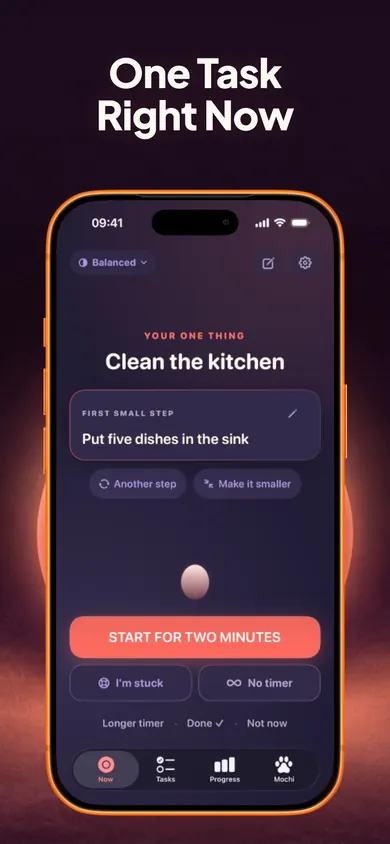
One task, one concrete first step, a visible timer, stop allowed. It does not clean the house. It gets you into the room, which is where the house gets cleaned. This is what Now is built around, and what the quiz above hands you.
The National Institute of Mental Health lists trouble organising tasks and difficulty getting started among the inattentive symptoms adults report. Knowing that will not clean the kitchen, but it should take "lazy" off the table. CHADD's adult overview is a fair next read if you want the fuller picture.
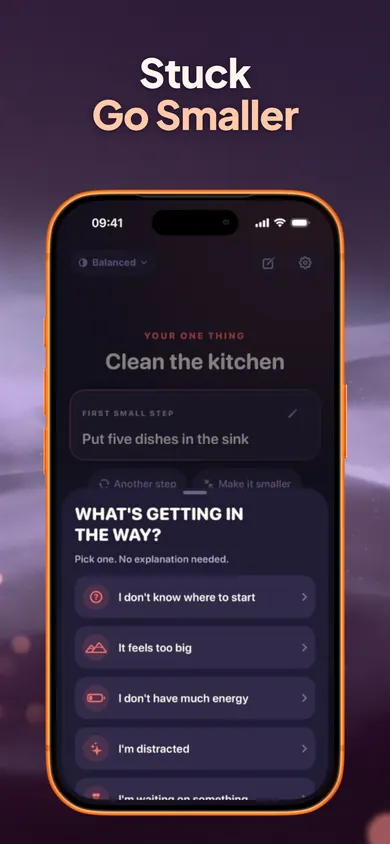
These are the real screens from the App Store listing. One task at a time, a first step you can edit or make smaller, and the stuck picker the quiz borrows from.


What it does not do, so you are not surprised: it will not plan your week, sync to a family calendar, or reward you with confetti. It is free, there is no account, and the Brain Dump box is there for the forty things in your head so they stop competing with the one you picked.
Make it a habit with NowWanting to and starting are two different jobs in the brain. Starting is an executive function, and executive functions are what ADHD affects most: planning, holding a sequence in mind, and choosing a first action from many. The National Institute of Mental Health lists trouble organising tasks and getting started among adult ADHD symptoms. That is why the problem is the first step, not your character.
Not on its own. Lots of tidy people have ADHD and lots of messy people do not. A house that stays overwhelming no matter how hard you try, alongside the other patterns on this page, is worth raising with a clinician. This is general information, not medical advice. Talk to your clinician.
There is no fast way, and pages that promise one are selling something. What works is lowering the cost of starting: one room, one concrete step, a short visible timer, and permission to stop. Most people find the second two minutes easier than the first.
No. It does one small thing: you type a task, it suggests a first step you can edit, and a two-minute ring counts down. If you tap I'm stuck, it asks what is in the way, with the same six reasons as the quiz above, and gives one next move. It is free, has no account, and does not nag you with streaks.
If you can afford it, the ADDitude article linked above suggests exactly that, and there is no shame in it. Most of the moms who wrote to us cannot, or the problem is the daily reset between cleaner visits. The quiz is about that daily reset.
No. It sorts the way you get stuck into six everyday patterns so you can pick a first step. It is not a screening tool. If you think you might have ADHD, the first step is a conversation with a GP or clinician, and that is a better use of two minutes than any room.
This is general information, not medical advice. Talk to your clinician.
Share the public guide. Your entries and results are not included.
Open the public guide link