Updated November 2026 · For grandparents, one screen, two heads
Stop quizzing them.Start arguing with them.
A history game to play with grandkids that asks "which came first?" and "how do we know?" instead of "what is the capital of". Five rounds below. Tap one to find out.
PastRush · Free on iPhone and iPad
Which came first?
Ötzi, by about 3,100 years. He died around 3300 BC; the stone was carved in 196 BC. Grandkids usually get this one wrong because the stone looks older.
Which came first?
The mechanism, by a century or more. It was made around 100 BC or earlier; Pompeii was buried in AD 79. A Greek gearbox predates the Roman ash.
Which came first?
The Black Death, by about a century. It arrived in 1347; Gutenberg's press was working around 1450. Ask which one changed more lives and watch the argument start.
Which came first?
The asteroid, by a very long way: about 66 million years ago. The last mammoths, on Wrangel Island, lived until roughly 4,000 years ago, which means mammoths were alive while the pyramids were being built.
Which came first?
Stonehenge, by around 3,500 years. The first stone settings date to about 2500 BC; the Norse were in Newfoundland around AD 1000. Both were news to the grandkids we tried this on.
Three ways to do history at the kitchen table
The trivia night
Dates, capitals, kings. Fast, and the grandparent wins every time, which is fun for exactly one of you.
The documentary
Lovely, and an hour long, and nobody has to decide anything. The child is a passenger.
The case file
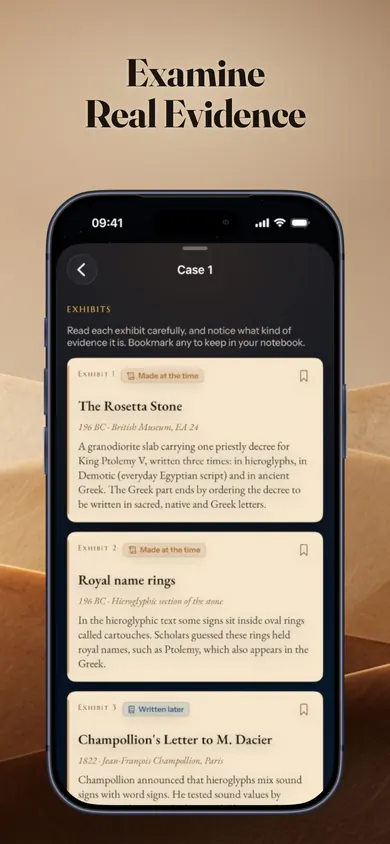
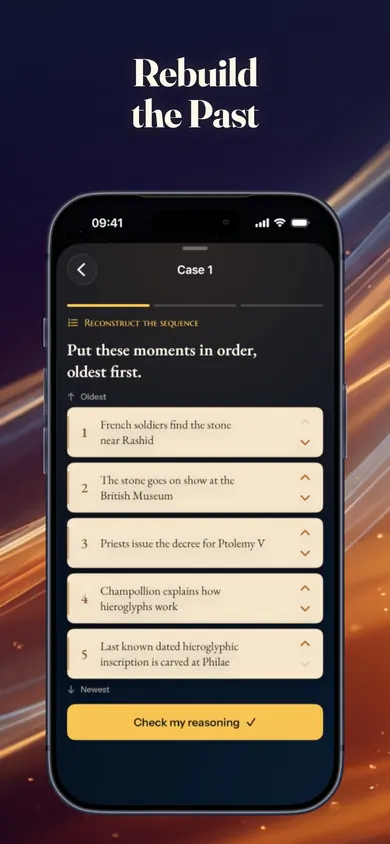
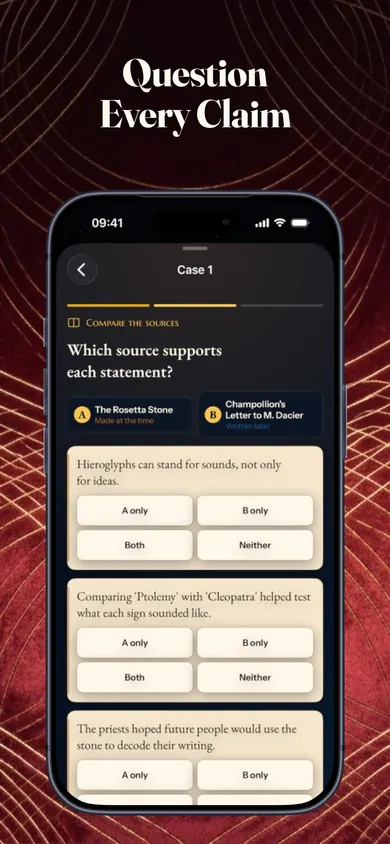
Real exhibits, labelled by what kind of evidence they are. You put events in order, weigh one source against another, and decide what the evidence can prove. Everybody has to commit to an answer, and the answer explains why. That is what PastRush is, and it works best with two people disagreeing.
Exhibits, labelled: made at the time, written later, scientific finding or reconstruction.
Rebuild the order. BC and AD handled properly.
Which source supports this? Sometimes neither.
The free investigations start with the Rosetta Stone, which the British Museum's own object page covers well if a grandchild wants to go deeper, and the rock layers of the Grand Canyon, where the National Park Service has the geology for the adult to read first.
Who it is not for
Grandchildren under about eight. The reading is real and the questions need patience; play the five rounds on this page aloud instead.
Anyone wanting a fast, flashy quiz with a timer. This is slow by design.
Families who need every investigation free. Six are, six are a one-time purchase, and we would rather say that here than have you find out on the sofa.
Android households. It is an iPhone and iPad app.
Questions grandparents ask
What age are grandkids for this?
The five rounds above work from about eight up, read aloud. The app itself asks players to compare sources and decide what evidence proves, which is roughly the thinking a 10-to-14-year-old does in school history, though plenty of adults enjoy it on their own. Check the age rating on the App Store listing for your own decision; we do not set it.
Do we need two devices?
No. One iPhone or iPad, passed back and forth, is how most families play. The investigations are built around reading an exhibit together and arguing about it, which is the point.
Is it free?
Six of the twelve investigations are free for everyone: the Rosetta Stone, Pompeii, the rock layers of the Grand Canyon, Ötzi the Iceman, continental drift and the Norse in Vinland. The other six come with a one-time purchase the listing calls Founder Lifetime. There is no subscription. Which Came First?, Where in the World?, Dive and the collectible Album are part of the free app.
Is the history accurate?
Every exhibit is labelled as made at the time, written later, a scientific finding or a modern reconstruction, and every answer explains why and links to the source behind it. Dates that historians still debate are left out of Which Came First? so each round has one right answer. The story pictures are AI-assisted illustrations and are marked as such, never shown as photographs of real objects.
Will a grandchild be sold things?
Cards in the Album are earned by playing, never sold. The only purchase is the one-time Founder Lifetime purchase that adds the six extra investigations. We describe only what the App Store listing shows; read it yourself before handing over a device, as you would with any app.
Can my grandchild play it alone?
Yes, but it is better with a second head in the room. The game asks "what can we conclude?" and sorts claims into supported and going too far. That is a conversation, and grandparents are good at it.
Sunday, after the roast
A composite scenario, not a customer story.
Margaret, 71, has a grandson of eleven who answers every question with "fine". She has tried the quiz book. She has tried the documentary, during which he watched his own reflection in the dark bits. What finally works is a tablet between them and a question with no safe answer: did the Black Death come before or after printing?
He says printing. She says plague, but does not say why. The app says plague, by a century, and then shows them a chronicle written at the time and a history written four hundred years later and asks which one supports the claim that "a third of Europe died". He says both. She says the later one is guessing. They are, for the first time in a year, arguing about something that is not screen time.
They do the Rosetta Stone the next Sunday. He wants the Antikythera one, which is in the paid set, and she buys it once and does not think about it again. The album card for Ötzi, he informs her, is Legendary, and rarity is a game label and not a measure of historical importance. He read that in the app. She did not know he read anything.
PastRush is a game, not a curriculum. It covers twelve investigations, not the sweep of history, and it leaves out dates that historians still argue about, which means some of the most interesting arguments are not in it. The illustrations are AI-assisted and labelled as such. The five rounds on this page use dates that are widely accepted, rounded; a grandchild who checks and finds a better source has learned the thing the game is for. We make the app, so read the App Store listing yourself before you decide.
One screen. Two heads.
Free on iPhone and iPad. Six investigations free, no subscription.
Apollo 11 Moonwalk Timeline PuzzleOrder five moonwalk records using mission time and UTC. This free browser exercise includes a clock conversion, elapsed-time question and NASA source key.
Useful for someone else?
Share the public guide. Your entries and results are not included.