Job payment planner
Get paid as the job goes, not after.
Enter the job total, a deposit and how many progress payments you want. Get a schedule with amounts and due dates, plus a chart of cash in against cash out that shows when you are paying for the job yourself.
Nothing is saved or sent. Costs are assumed to be paid as they come: materials on day 0, the rest spread evenly over the job.
| Payment | Share | Amount | Due |
|---|
Free tool from Solo Work Tools
How to set up a payment schedule for a small job
A payment schedule says how much the customer pays and when. For a small job it usually has three parts: a deposit when the quote is accepted, one or more progress payments while the work is under way, and a final payment when the customer signs off. The calculator splits the total across those three and puts dates on each one.
The deposit
The deposit does two jobs. It shows the customer is committed, and it pays for what you have to buy before work starts. Many contractors ask for somewhere between 10 and 50 percent depending on the trade, the size of the job and how much material has to be ordered. The calculator tells you what share of your up-front materials a given deposit covers, and the deposit that would cover them in full.
Some places set a limit on the deposit for home improvement work, and some require particular wording in the contract. Check your local rules before you fix the number.
Progress payments
Progress payments spread the middle of the job. They are easiest to defend when they are tied to something the customer can see, such as the rough work finished or the materials on site, rather than to a date alone. This calculator spaces them evenly across the job length so you can see the effect on cash, and you can then rename them to match your own stages.
The final payment
Keeping a share of the price until the customer signs off gives you both a reason to finish the last small items. On larger projects this is called retainage or a holdback. On a small job a final payment of 10 to 25 percent due on completion does the same thing. A bigger final payment means more of the job is paid for after the work is done, which shows up as a deeper dip in the cash chart.
What the cash chart shows
The orange line is the money the customer has paid you so far. The grey line is the money you have spent. When the grey line is above the orange one you are paying for the customer’s job out of your own pocket, and the vertical marker shows the worst point. The numbers assume you pay for materials on day 0 and spread the other costs evenly, so treat it as a planning aid and adjust the inputs to match how your costs really fall.
| Common pattern | Deposit | In between | Final |
|---|---|---|---|
| Short job, a day or two | 50% | None | 50% |
| Job of one to three weeks | 25% | Two payments | 20% |
| Larger job, several stages | 20% | Three or four payments | 10% |
These are examples of how people split jobs, not rules. Put the agreed schedule in your written quote, and check local rules on deposits and contract wording. This is a planning tool and is not legal advice.
Questions people ask
How much deposit should a contractor ask for?
There is no single right number. It depends on the trade, the job size, how much material you must buy first and local rules. Many small-job contractors ask for enough to cover the materials they have to buy before work starts.
What is a progress payment?
A payment made part-way through the job, usually when a stage is finished. It keeps the customer from owing the whole price at the end and keeps you from paying all your costs in the meantime.
What is a holdback or retainage?
An amount the customer keeps back until the work is accepted. On small jobs it is usually just a final payment due at sign-off.
How do I know if I am paying for the job out of my own pocket?
Compare the money received so far with the money spent so far. The chart in the calculator draws both lines and marks the worst point, which is the most you have laid out before the next payment arrives.
Is a payment schedule a contract?
No. It is a plan. Write the agreed amounts and dates into your quote or contract, and check your local rules on deposits and wording.

The quantity is sorted. Now price the job.
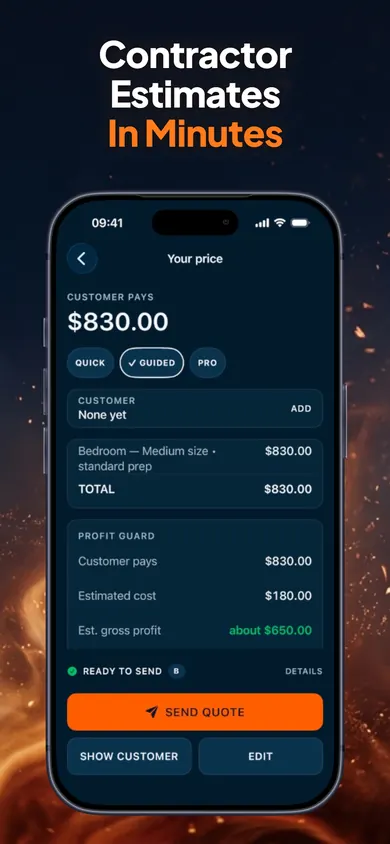
ScopeBid: Estimate & Invoice is an offline estimate and invoice app for independent service professionals, on iPhone and iPad. Its listing says Profit Guard shows gross margin and markup side by side before a quote is sent, and each quote goes out as a PDF.
Get ScopeBid on the App StoreYour first three quotes are free with full PDFs. ScopeBid Pro is an optional auto-renewing subscription for unlimited quoting and the wider job-costing and invoicing workflow. Check the App Store for current terms.
Honest Little Apps publishes both ScopeBid and this page. This is a separate browser tool and does not sync with the app. App details checked November 10, 2026.
On a computer? Open it on your iPhone