Word memory test
Seen it before, or is it new?
One word at a time. If it has already come up in this run, press Seen. If not, press New. It is easy for the first twenty words. Then it is not.
Press start for the first word.
Keyboard: S or left arrow for Seen, N or right arrow for New. Words are shuffled differently every run.
Free tool from Focus and Screen Time
What this measures
Deciding whether you have met a word before is recognition memory, and doing it while new words keep arriving loads working memory too. Each word you see has to be stored well enough to tell it apart, later, from words that only feel familiar because they are ordinary.
Why familiar words trip you up
Every word in the test is common, so all of them feel a little familiar. The task is not "do I know this word?" but "did I see it in the last few minutes?", and those two feelings are easy to confuse. Mistakes tend to be false alarms: pressing Seen for a new word that resembles an earlier one, such as "garden" after "orchard".
Ways to score higher
- Picture it. A quick mental image of a lantern or an anchor leaves a stronger trace than the letters do.
- Link words together. A lantern hanging from an anchor is one memory holding two words.
- Say it silently. Hearing the word in your head adds a second way back to it.
- Trust the first reaction. A long hesitation usually ends in talking yourself into the wrong answer.
Reading your score
The score is how many words you judged correctly before losing three lives. There is no official scale for this version, and the run is short, so luck plays a part. Treat it as a game against your own best. It is not a clinical memory assessment.
Questions people ask
How does the verbal memory test work?
Words appear one at a time. You press Seen if the word has already appeared in this run and New if it has not. Three mistakes end the run.
What is a good verbal memory test score?
There is no official scale for this version. Most people find it gets hard somewhere after twenty or thirty words; aim to beat your own best.
How can I improve my memory for words?
Form a quick mental picture of each word and link new words to earlier ones. Images and associations are remembered far better than bare letters.

Liked that? There are five more a day.
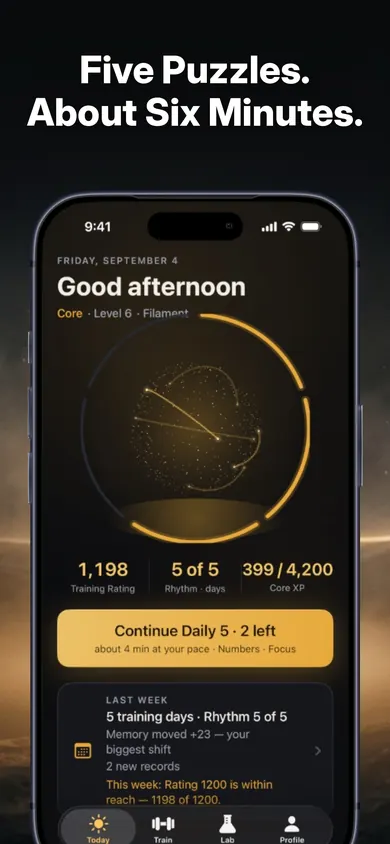
Cognilo: Brain Training Games is an iPhone app of short puzzles. Its listing says the free Daily 5 draws from memory, focus, logic, number, spatial and language puzzles.
Get Cognilo on the App StoreIts listing describes a free Daily 5. Check the App Store for current details on any optional paid features. Brain-training games are practice and entertainment, not a medical assessment or treatment.
Honest Little Apps publishes both Cognilo and this page. This is a separate browser tool and does not sync with the app. App details checked November 10, 2026.
On a computer? Open it on your iPhone