Nutrient line map 5 lines, 29 stops
Where does a nutrient go after you swallow it?
Pick a line and ride it stop by stop: where the nutrient gets in, what limits it, where the body keeps it and how it leaves.
Short answer to the one people ask most
Vitamin B12 is absorbed in the distal ileum, the last stretch of the small intestine. It only gets in after it has bound intrinsic factor, a protein made in the stomach.
General education from published reference sheets. Not advice about your own health, diet or supplements.
1The long way round
Vitamin B12: where it goes
B12 cannot be absorbed on its own. It is handed between three proteins before it gets in, and it gets in at the very end of the small intestine.
Stop 1 of 6
Mouth
Saliva frees a little B12 from food. That B12 is picked up by haptocorrin, a binding protein in saliva.
Stop 2 of 6
Stomach
Hydrochloric acid and a protein-cutting enzyme release more B12 from food. Cells in the stomach lining also secrete intrinsic factor, the protein B12 will need later. B12 in fortified foods and supplements is already free, so it skips the release step.
Stop 3 of 6
Duodenum
Digestive enzymes separate B12 from haptocorrin. The freed B12 binds intrinsic factor.
Stop 4 of 6
Distal ileum
This is where B12 is absorbed: the last stretch of the small intestine takes up the B12 and intrinsic factor pair together. The system is small. It is full at roughly 1 to 2 micrograms per dose, so about half of a small dose gets in, but only about 2% of a 500 microgram dose and about 1.3% of a 1,000 microgram dose.
Stop 5 of 6
Body stores
The body holds about 1 to 5 milligrams of B12, roughly 1,000 to 2,000 times what is typically eaten in a day. That reserve is why a shortfall can take several years to show.
Stop 6 of 6
At work
B12 is required for healthy red blood cell formation, for making DNA, and for developing and insulating the nervous system (myelination).
Every stop on this line was checked against the NIH Office of Dietary Supplements Vitamin B12 fact sheet for health professionals.
2The guarded gate
Iron: where it goes
Iron is controlled on the way in. Routine losses are small, so the gut and one hormone decide how much is allowed through.
Stop 1 of 7
On the plate
Iron arrives in two forms. Heme iron comes from meat, poultry and seafood; it is only about 10% to 15% of iron intake in Western diets but is absorbed more readily. Nonheme iron comes from plants and fortified foods.
Stop 2 of 7
Stomach
Stomach acid helps the body absorb nonheme iron. Medicines that lower stomach acid can reduce iron absorption.
Stop 3 of 7
Intestine
How much gets in depends on the whole meal: roughly 14% to 18% of iron is absorbed from mixed diets that include meat, seafood and vitamin C, and roughly 5% to 12% from vegetarian diets. Phytate in grains and beans and some polyphenols hold nonheme iron back.
Change here for the Vitamin C lineStop 4 of 7
The gatekeeper
Hepcidin, a hormone circulating in the blood, is the key regulator of how much iron is absorbed and where it is distributed.
Stop 5 of 7
Red blood cells
An adult carries about 3 to 4 grams of iron, and most of it is in hemoglobin, the oxygen-carrying protein in red blood cells. Muscle holds iron in myoglobin.
Stop 6 of 7
Storage
Spare iron is kept as ferritin, and as hemosiderin, mainly in the liver, spleen and bone marrow.
Stop 7 of 7
Exits
Only small amounts of iron leave through urine, feces, the gut lining and skin. Menstrual blood loss adds to that.
Every stop on this line was checked against the NIH Office of Dietary Supplements Iron fact sheet for health professionals.
3The bone bank
Calcium: where it goes
Nearly all of the body's calcium is in bone, and bone lends it back whenever blood levels need topping up.
Stop 1 of 5
Intestine
Calcium crosses the gut wall two ways: active transport and passive diffusion. Active transport does most of the work when intake is low, and it needs vitamin D.
Change here for the Vitamin D lineStop 2 of 5
How much gets in
The share absorbed falls as intake rises: about 45% at 200 mg a day, about 15% above 2,000 mg a day. Adults net about 25%; infants and young children up to about 60%. About 30% is absorbed from dairy and fortified foods, but only about 5% from spinach, because oxalic acid binds the calcium.
Stop 3 of 5
Blood
Blood calcium is held in a tight range. The small ionized pool there drives blood vessel tightening and relaxing, muscle function, blood clotting, nerve signals and hormone release.
Stop 4 of 5
Bone
About 98% of the body's calcium is stored in bone: about 1,200 grams in adult women and about 1,400 grams in adult men. Bone is the reservoir. Constant remodeling, breaking down and rebuilding, keeps blood calcium steady.
Stop 5 of 5
Exits
Calcium leaves in urine. After menopause, lower estrogen increases urinary calcium loss and bone breakdown.
Every stop on this line was checked against the NIH Office of Dietary Supplements Calcium fact sheet for health professionals.
4Two stops to switch on
Vitamin D: where it goes
Vitamin D from sun, food or supplements is inert. It has to be changed twice, in two different organs, before it does anything.
Stop 1 of 6
Skin
UVB light on uncovered skin converts a precursor there into vitamin D3. Season, cloud, skin melanin and sunscreen change how much forms, and UVB does not pass through window glass.
Stop 2 of 6
Food and upper small intestine
Fatty fish and fish liver oils are among the richest natural sources; fortified foods such as milk supply most of the vitamin D in the U.S. diet. It is fat-soluble and absorbed in the upper small intestine, so it depends on the gut's ability to absorb fat.
Stop 3 of 6
Liver
First change: the liver converts it to 25-hydroxyvitamin D, also called calcidiol. This is the form a blood test measures, with a half-life of about 15 days.
Stop 4 of 6
Kidney
Second change, mainly in the kidney: it becomes 1,25-dihydroxyvitamin D, or calcitriol, the active form. Its half-life is short, about 15 hours, and its level is tightly regulated.
Stop 5 of 6
At work
Active vitamin D promotes calcium absorption in the gut and helps keep blood calcium and phosphate where normal bone mineralization needs them. Deficiency causes rickets in children and osteomalacia in adults.
Change here for the Calcium lineStop 6 of 6
Storage
Vitamin D made from sun exposure can be stored in the liver and in fat.
Every stop on this line was checked against the NIH Office of Dietary Supplements Vitamin D fact sheet for health professionals.
5The short loop
Vitamin C: where it goes
Humans cannot make vitamin C and keep only a modest pool. It comes in, does its work, and the surplus goes straight out.
Stop 1 of 5
No factory
Unlike most animals, humans cannot make vitamin C. All of it has to come from food or supplements.
Stop 2 of 5
Intestine
A dedicated, dose-dependent active transporter moves vitamin C across the gut wall. About 70% to 90% is absorbed at intakes of 30 to 180 mg a day; above 1 gram a day, less than half is.
Stop 3 of 5
Tissues
Cells hold far more than blood does. Concentrations are highest in white blood cells, the eyes, the adrenal and pituitary glands and the brain. The whole body holds from about 300 mg, which is near scurvy, to about 2 grams.
Stop 4 of 5
At work
Vitamin C is needed to make collagen, which supports connective tissue and wound healing. It acts as an antioxidant, and it improves absorption of nonheme iron from plant foods.
Change here for the Iron lineStop 5 of 5
Exit
Absorbed vitamin C that the body does not use is excreted in urine.
Every stop on this line was checked against the NIH Office of Dietary Supplements Vitamin C fact sheet for health professionals.
All five at a glance
| Nutrient | Gets in at | What limits it | Where it is kept | How it leaves |
|---|---|---|---|---|
| Vitamin B12 | Distal ileum, bound to intrinsic factor | Intrinsic factor is full at about 1 to 2 mcg per dose | About 1 to 5 mg in body stores | Not covered on this map |
| Iron | Intestine; stomach acid helps nonheme iron | Hepcidin; about 5% to 18% absorbed depending on diet | Hemoglobin; ferritin in liver, spleen, bone marrow | Small losses in urine, feces, gut lining, skin; menstrual blood |
| Calcium | Intestine, by active transport and diffusion | Needs vitamin D; share absorbed falls as intake rises | About 98% in bone | Urine |
| Vitamin D | Made in skin; absorbed in upper small intestine with fat | Must be converted in liver, then kidney | Liver and fat | Not covered on this map |
| Vitamin C | Intestine, by an active transporter | Under half absorbed above 1 g a day | Tissues; 300 mg to 2 g in the whole body | Urine |
"Not covered on this map" means the fact sheet used for that line does not describe it, so this page does not guess.
Six stops from memory
Cover the map and try these. Each answer points back to the stop it came from.
The moving version
Watch all 14 journeys on a body map.
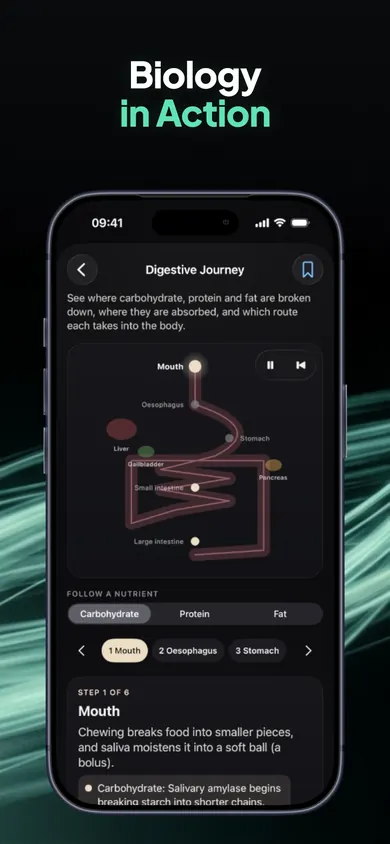
Body Unpacked is an iPhone app that follows each of 14 nutrients on an animated body map: where it is absorbed, what carries it, where it is stored, where it works and how it leaves. Every journey cites its source and ends with a quick check, like the one above.
It also starts from the food: pick one of 44 everyday foods, tap a nutrient and see what it does and where.
Get Body Unpacked on the App StoreFree to download. Requires iOS 18 or later. App details checked against the App Store listing on November 10, 2026. This web map is a separate companion and covers five of the nutrients.
Publisher disclosure: Honest Little Apps publishes both Body Unpacked and this page. This is not an independent review.
Questions this map answers
Where is vitamin B12 absorbed?
Vitamin B12 is absorbed in the distal ileum, the final section of the small intestine. Before that it is released from food in the stomach and bound to intrinsic factor, a protein secreted by cells in the stomach lining; the ileum absorbs the two together.
Why does B12 need intrinsic factor?
The ileum takes up B12 only as a pair with intrinsic factor. That system is full at roughly 1 to 2 micrograms per dose, which is why only about 2% of a 500 microgram supplement dose is absorbed. People with pernicious anemia lack intrinsic factor and cannot absorb B12 from food or supplements without treatment.
Where is iron stored in the body?
Most of an adult's 3 to 4 grams of iron is in hemoglobin in red blood cells. Spare iron is stored as ferritin and hemosiderin, mainly in the liver, spleen and bone marrow, and muscle holds some in myoglobin.
Where is vitamin D activated?
In two places. The liver converts vitamin D to 25-hydroxyvitamin D (calcidiol), the form measured in blood tests. The kidney then converts that to 1,25-dihydroxyvitamin D (calcitriol), the active form.
Does vitamin C help you absorb iron?
Yes, for nonheme iron, the form in plant foods and fortified foods. The NIH fact sheets list vitamin C as an enhancer of nonheme iron absorption, and note that in a typical mixed Western diet the effect of enhancers and inhibitors is small for most people.
How this page was made
Each stop restates what the matching NIH Office of Dietary Supplements fact sheet for health professionals says, in plainer words. Where a fact sheet is silent, for example on which blood protein carries B12, the map leaves the stop out. Sources were read on November 10, 2026: Vitamin B12, Iron, Calcium, Vitamin D, Vitamin C.
Written by Honest Little Apps. Free to link and to use in class with credit. Spot something wrong? The repository linked from the hub home page takes corrections.
Useful for someone else?
Share the public page. Your quiz answers are not included.
Open the public link