Updated November 2026 · For adults using prescribed GLP-1 medication under medical care

Stop fearing the number.Start learning the words.

Twelve terms people mix up about muscle on GLP-1, answered in a chat. Drag the slider to see what "40% lean mass" actually counted.

Download on the App StoreSturdy · Free on iPhone

What the headline says

40%

"of the weight you lose on semaglutide is muscle"

Repeated from a 2021 trial, with one word swapped.

What the DXA scan counted as "lean mass" in a 3 kg loss

  • Water
  • Glycogen
  • Organ tissue
  • Connective, intramuscular fat
  • Contractile muscle, est. 0.2–0.5 kg

Illustrative shares from Barbell Medicine's worked example; the scan itself reports one bucket.

HeadlineScan

Sources for both sides are in the chat below. Neither side says muscle loss is nothing; the right side says it is smaller than the word implies and that training changes it.

What the app records, with the words marked

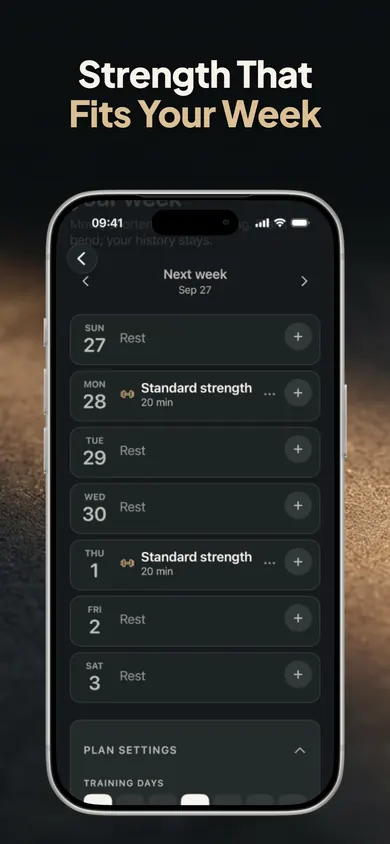
resistance training, 20 minSturdy weekly plan with two Standard strength sessions and rest days marked
Your week. Missed days stay unfilled, never "failed".
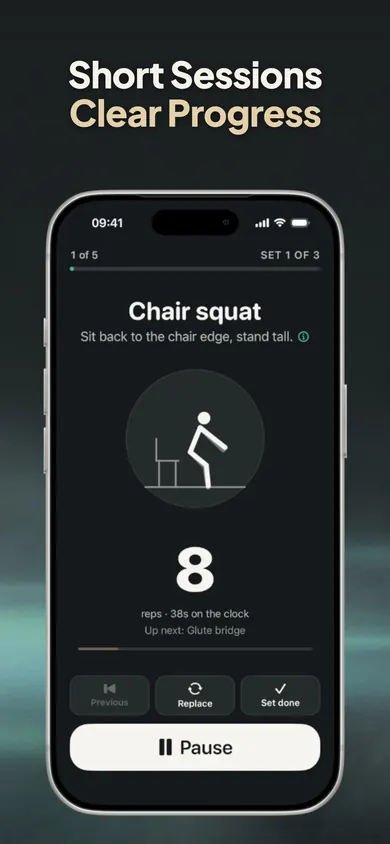
reps in reserve, your callSturdy guided session showing a chair squat with rep count and timer
Guided session: setup, reps, rest. Difficulty changes only when you choose.
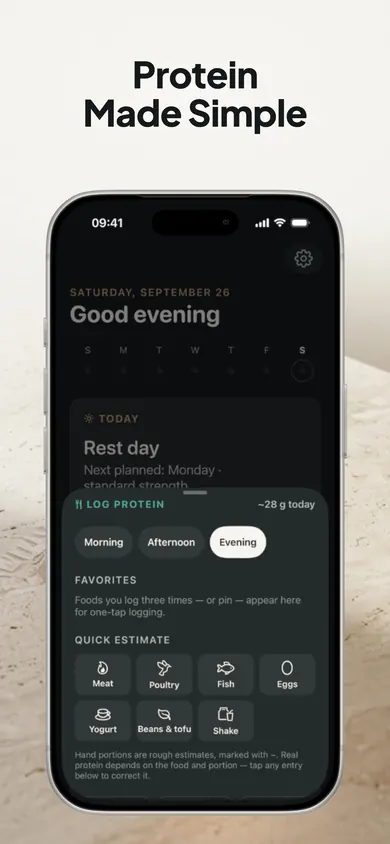
g/kg, your own targetSturdy protein log by meal period with quick-add foods and favorites
Protein by meal, from a label or a hand-portion estimate.

The words, one at a time

Lean mass

My doctor said people on these lose "40% lean mass". That is muscle, right?

Not quite. On a DXA scan the body is split three ways: bone, fat, and everything else. The "everything else" is called lean mass or lean soft tissue. It includes muscle, but also water, the glycogen stored in muscle and liver, your organs, connective tissue and even fat sitting inside muscle fibres. The scan cannot tell those apart. So "lean mass went down" means that whole bucket got lighter, not that it was all muscle.

Barbell Medicine's review walks through the bucket in detail.

The 40% figure

Where does the 40% come from, then?

From the 68-week STEP 1 trial of semaglutide, published in the New England Journal of Medicine in 2021. In a sub-group who had DXA scans, roughly 39% of the total weight lost was classified as lean mass. Two things are usually left out when that number travels: it is lean mass, not muscle (see above), and people lost about 15% of their body weight, so most of what went was fat.

Muscle mass

So what is muscle mass, if lean mass is not it?

The actual contractile tissue: the stuff that shortens and moves you. It is a slice of lean mass, not the whole thing. Consumer scales and most scans estimate it rather than measure it. Barbell Medicine's worked example puts the contractile muscle in a 3 kg DXA "lean loss" at somewhere between 0.2 and 0.5 kg, with water, glycogen and organ tissue making up most of the rest. Treat any single muscle-mass number as a rough estimate.

DXA (DEXA)

What is a DEXA scan and should I get one?

Dual-energy X-ray absorptiometry. Two low-dose X-ray beams pass through you and the machine works out bone, fat and lean soft tissue by how much each absorbs. It is the best common tool for body composition, and still only three buckets. If you get one, get the next one on the same machine, at the same time of day, similarly hydrated; water alone can move the lean number. Whether you need one is a question for your clinician, not for us.

Sarcopenia

My mum's letter says "risk of sarcopenia". Is that what I have?

Sarcopenia is the age-related loss of muscle mass and strength, usually diagnosed from grip strength, walking speed or a chair-stand test rather than a scan. Fast weight loss at any age can nudge you in that direction, which is why clinicians mention it. It is a diagnosis they make, not one you make from a word on a page. This is general information, not medical advice. Talk to your clinician.

Grams per kilo (g/kg)

Everyone says "eat more protein". How much is more?

Protein targets are written as grams per kilogram of body weight per day. The old 0.8 g/kg RDA was set to prevent deficiency in sedentary adults. For people losing weight and lifting, a 2018 meta-analysis in the British Journal of Sports Medicine found the benefit of extra protein on training results levelled off around 1.6 g/kg. For an 80 kg person that is roughly 130 g a day, which is a lot on a reduced appetite, so spreading it across meals matters. Your own target is between you and your clinician or dietitian; Sturdy lets you set it yourself or turn the goal off.

Resistance training

Is "resistance training" just a posh word for the gym?

It is any work where your muscles push or pull against something: a barbell, a band, a chair you stand up from, your own body on the floor. The reason it keeps coming up is that it is the thing with evidence behind it. A 2018 meta-analysis in Nutrients found resistance training prevented about 93% of the lean-mass loss from dieting alone in older adults with obesity, and a 2017 trial found the diet-plus-exercise group lost close to no lean mass while the diet-only group lost around 16% of their weight as lean mass.

Progressive overload

And "progressive overload"?

Doing a little more over time: another rep, a heavier band, a slower lowering, one more set. Muscle keeps what it is asked to do. The trap on a GLP-1 is that appetite and energy drop, so "more" has to be small and the measure has to be your own last session, not a chart. In Sturdy the difficulty only changes when you choose; it never ramps on its own.

Reps in reserve (RIR)

The app said "leave two reps in reserve". Reps in what?

How many more repetitions you could have done before form broke down. "Two in reserve" means stop while two more were still possible. It is a way to train hard enough to keep muscle without grinding to failure every set, which on reduced calories is the quickest way to feel wrecked. Most of the sensible guidance for people on weight-loss medication lands at 2 to 4 reps in reserve.

Chair stand (30-second)

What is the chair stand thing? It sounds too easy to mean anything.

Sit in a chair, arms crossed, stand fully and sit back down as many times as you can in 30 seconds. It is part of the CDC's STEADI fall-risk toolkit and it is a decent proxy for leg strength, which is the strength that gets you off the floor and up the stairs. Sturdy includes it as an optional check-in; you record the count and conditions and it shows your history without scores, age norms or medical conclusions, on purpose.

Body recomposition

People online say they "recomped". What happened to them?

Losing fat while keeping or adding muscle, so the scale moves less than the mirror does. It is the realistic goal on a GLP-1 with training and enough protein: you will not add much muscle in a deficit, but you can hold on to most of what you have. Be wary of before-and-after photos as evidence; lighting and water do a lot of work in those.

Protein consistency

The app tracks "protein consistency" rather than a total. Why?

Because on a reduced appetite the problem is rarely one heroic day; it is the string of days where lunch was a yoghurt. Consistency means how many days you got near your own target, or simply whether each meal had some protein in it. Sturdy lets you log grams from a label, use hand-portion estimates that are labelled as estimates, or switch to meal checkmarks if counting is not for you.

Questions people ask

Does GLP-1 medication cause muscle loss?

Any fast weight loss, with or without medication, takes some lean mass with it, and some of that is muscle. The published trial data report lean mass from DXA, which is a wider bucket than muscle. Resistance training and adequate protein are the two things with evidence for keeping most of it. Your prescriber is the person to ask about your own situation.

How much protein should I eat on Ozempic or Wegovy?

Research in people who are losing weight and training points to roughly 1.2 to 1.6 g per kg of body weight per day, well above the 0.8 g/kg set for sedentary adults. The right number for you depends on kidney health, appetite and what your clinician says. Sturdy does not set a target for you; you set it, or turn it off.

Can I rebuild muscle after losing it on a GLP-1?

Muscle responds to training at any age, and strength often comes back faster than size. The reviews linked above found that people who trained during weight loss kept most of their lean mass in the first place, which is easier than rebuilding. Start with short sessions and leave reps in reserve.

Is Sturdy a medical app?

No. It is a strength planner and protein log for adults using GLP-1 or other prescribed weight-management medication under medical care. It does not give dosing or injection advice, does not measure muscle or bone, and shows your history without scores or medical conclusions. Its medication log is a record of what you took, nothing more.

Do I need a DEXA scan to use this?

No. Sturdy records sessions, loads, protein and optional check-ins like the chair stand. If you have DXA results, they live with your clinician; the app does not read or interpret them.

Week three, a kitchen

A composite scenario, not a customer story.

Rae is 54, eleven weeks into a prescribed GLP-1 and nine kilos down. She has read the 40% figure four times this month, once in a group chat with a skull emoji. What she has not read is what "lean mass" means, so she has quietly decided the medication is dissolving her, and that the only answer is to eat less protein because it fills her up and she cannot finish anything anyway.

What actually changes her month is two words. "Lean mass" turns out to be a bucket with water in it, which explains why the number on the scale jumped when she started training. "Grams per kilo" turns out to be a target she can set herself, and 1.2 g/kg for her weight is about 95 g, which is not heroic when it is spread over four meals and a yoghurt. She does the 30-second chair stand on a Sunday: 11. Three weeks later, with two 20-minute sessions a week and the reps left in reserve: 14. No score, no age norm, just her own number going the right way.

She still asks her GP about the DXA. That is the right person to ask.

Make it a habit with Sturdy

Honest limits

Sturdy cannot measure muscle, bone or body composition, and neither can this page. The shares in the slider are illustrative, taken from a published worked example, and the scan behind the 40% figure reports a single bucket. Protein targets and whether you should train at all are questions for your clinician, especially with kidney, heart or joint conditions. The app gives no dosing or injection advice and its medication log is a record only. This is general information, not medical advice. Talk to your clinician.

Keep the strength you have.

Free on iPhone. No account, no scores, no medical conclusions.

Download on the App Store

Useful for someone else?

Share the public guide. Your entries and results are not included.

Open the public guide link